These are called magic eye by many but are technically stereograms.
Firstly it requires two working eyes. That can align together.
So people with cross eye or a lazy eye can’t do these. Though these can be used to help such people train their eyes to work together better.
They are easier to learn to do as a kid. Adults who never have successfully done the trick really struggle with it. But it’s not impossible to learn.
Also. For some people they make people feel nauseous.
Also. The more you practice the easier it gets.
You build up an ability rather quickly because it’s muscles you already use. You are just learning to "decouple accommodation and vergence "
By this I mean. When you look at something with both eyes, they converge together at that point in space. The angles of each eye meets.
Accommodation in vision refers to how the lens in your eye (the one behind the iris, not the cornea) changes in shape to focus light. Like how a focusing ring on a camera works.
Vergence and accommodations are synergistically linked. Meaning the often influence one another and function together. Each providing feedback to other to tune that ability to look at something with both eyes and it be brought to focus.
Here is how it relates to stereograms.
The trick to see them is to disconnect your accommodation from vergence.
Your eyes must converge to a point farther away than the actual location of the image. But accommodation must match the actual image location.
You are looking farther away yet your eye is focusing on the image. So it’s clear and not blurry.
You can also do this where the vergence is in front of the image but that’s way harder and took me a while to get the hang of it. It also causes more eye strain. These magic eye images are not intended to be viewed that way.
Now that you know the mechanism , this might help you figure out tactics to see the image.
Essentially it looks like 3d objects covered in wall paper pattern. There aren’t any surface details. Just 3d shapes.
Somehow I can only do them cross-eyed. I know with most of them are supposed to focus the eyes behind the image, but that never worked for me properly. I think I see the shapes “cut out” of the image rather than “poking out”…

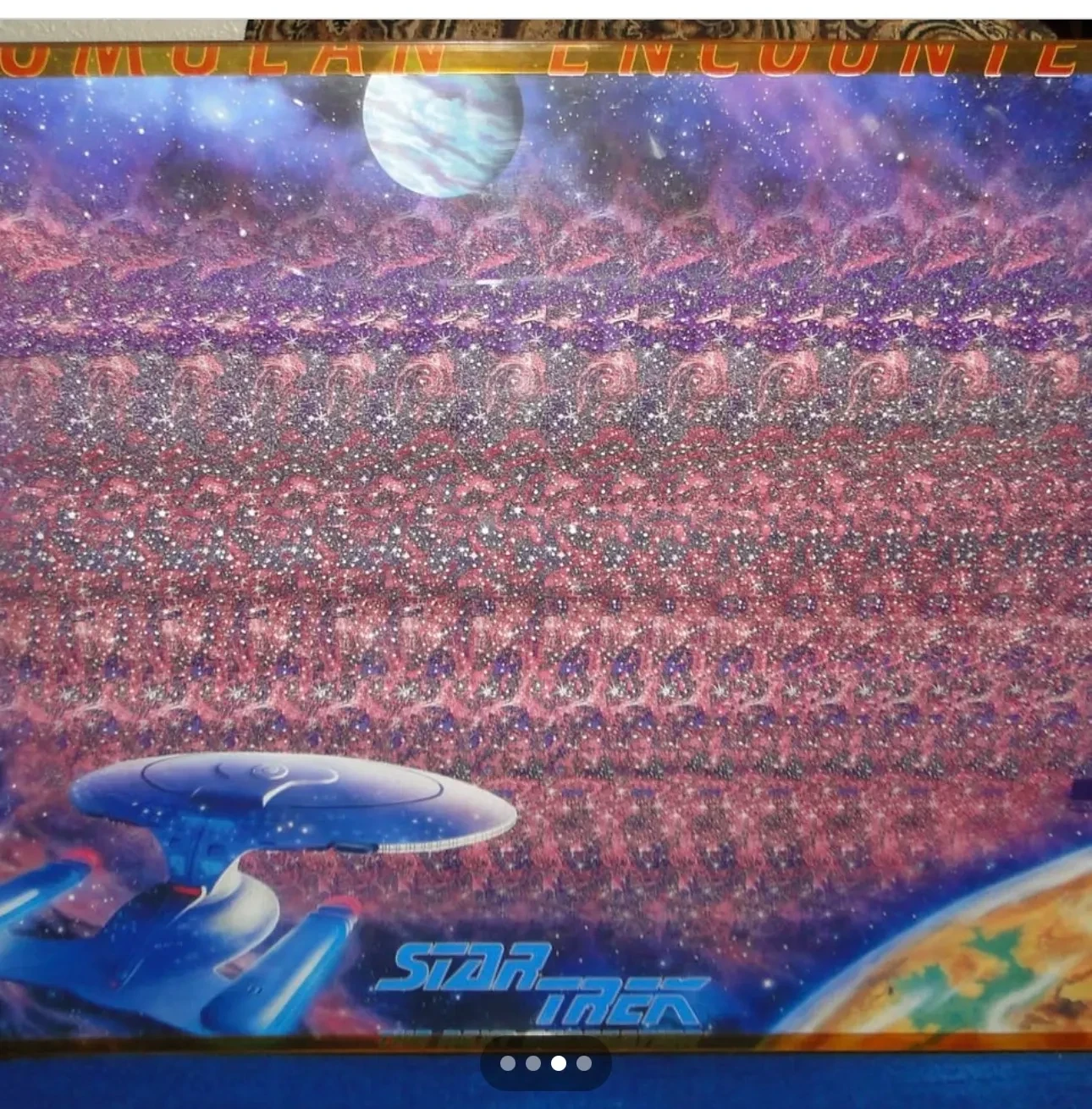
These are called magic eye by many but are technically stereograms.
Firstly it requires two working eyes. That can align together.
So people with cross eye or a lazy eye can’t do these. Though these can be used to help such people train their eyes to work together better.
They are easier to learn to do as a kid. Adults who never have successfully done the trick really struggle with it. But it’s not impossible to learn.
Also. For some people they make people feel nauseous.
Also. The more you practice the easier it gets.
You build up an ability rather quickly because it’s muscles you already use. You are just learning to "decouple accommodation and vergence "
By this I mean. When you look at something with both eyes, they converge together at that point in space. The angles of each eye meets.
Accommodation in vision refers to how the lens in your eye (the one behind the iris, not the cornea) changes in shape to focus light. Like how a focusing ring on a camera works.
Vergence and accommodations are synergistically linked. Meaning the often influence one another and function together. Each providing feedback to other to tune that ability to look at something with both eyes and it be brought to focus.
Here is how it relates to stereograms.
The trick to see them is to disconnect your accommodation from vergence.
Your eyes must converge to a point farther away than the actual location of the image. But accommodation must match the actual image location.
You are looking farther away yet your eye is focusing on the image. So it’s clear and not blurry.
You can also do this where the vergence is in front of the image but that’s way harder and took me a while to get the hang of it. It also causes more eye strain. These magic eye images are not intended to be viewed that way.
Now that you know the mechanism , this might help you figure out tactics to see the image.
Essentially it looks like 3d objects covered in wall paper pattern. There aren’t any surface details. Just 3d shapes.
Hope that helps!
Somehow I can only do them cross-eyed. I know with most of them are supposed to focus the eyes behind the image, but that never worked for me properly. I think I see the shapes “cut out” of the image rather than “poking out”…
Here is a test:
If you want to see stereogram images designed for cross-view, check out [email protected]
Oh man, thanks for this! Subscribe