

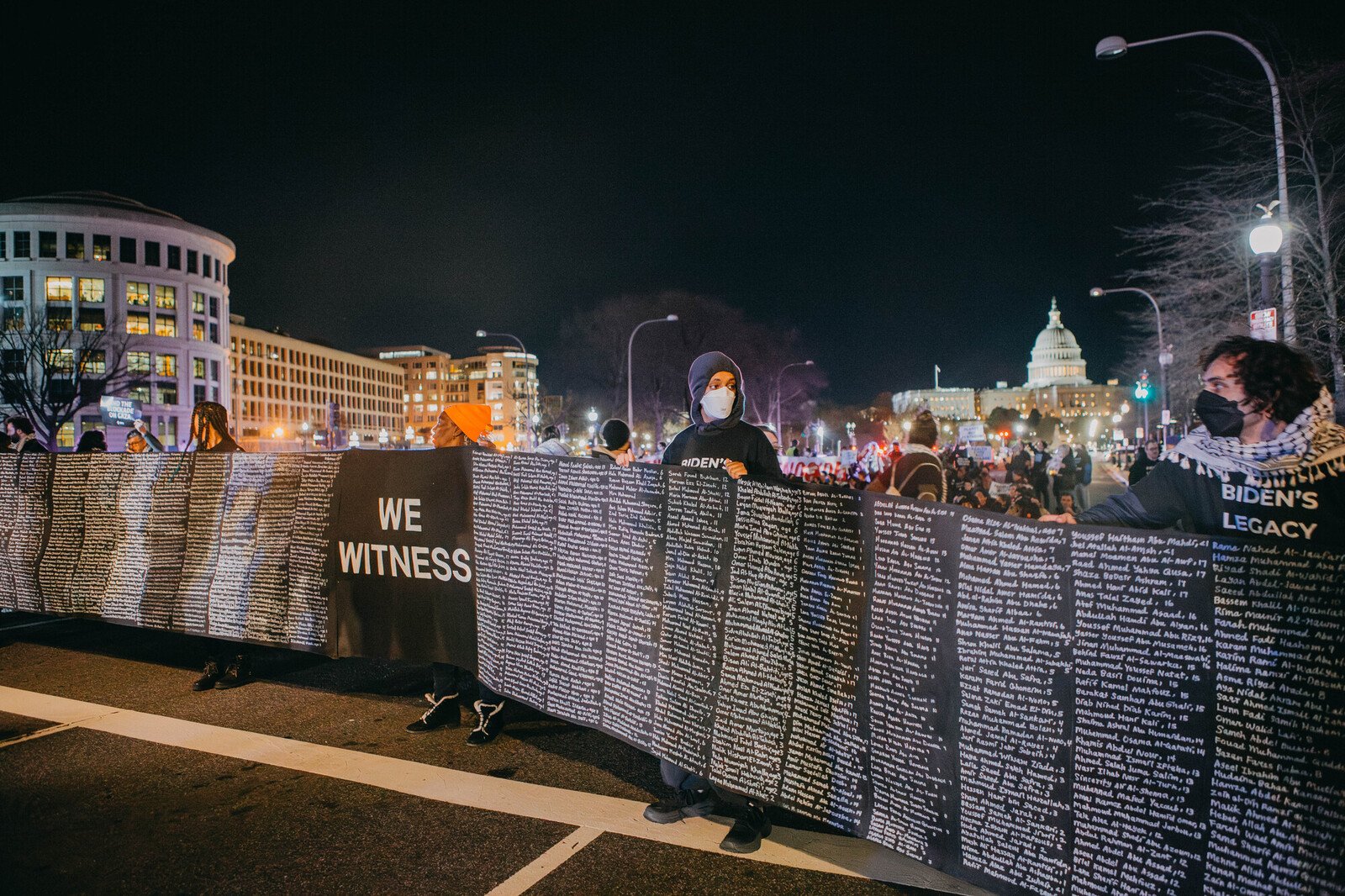
After receiving the text for the ad quoted above, a representative from the advertising team suggested AFSC use the word “war” instead of “genocide” – a word with an entirely different meaning both colloquially and under international law. When AFSC rejected this approach, the New York Times Ad Acceptability Team sent an email that read in part: “Various international bodies, human rights organizations, and governments have differing views on the situation. In line with our commitment to factual accuracy and adherence to legal standards, we must ensure that all advertising content complies with these widely applied definitions.”
Yes and in the Bosnian genocide there were not credible claims that the deceased were incidental casualties, which are permissive and expected in war. There were soldiers going door to door murdering families, lining them up and shooting them, sometimes hundreds at a time. You know, actual genocide.
Nothing like that has happened in Gaza, not even allegedly. There’s been some mistakes and some definite war crimes. That’s all war, though.
deleted by creator
No not at all. Israel actually prosecutes war criminals and will continue to do so. That’s unlike Gaza, where war crimes are rewarded with cash prizes, paid in Iranian Dinar.
That’s the leadership the world expects from Hamas; let everyone starve so they can build out tunnels and buy rocket launchers, get 50,000 people killed as voluntary and involuntary human shields, and then sit back and let Qatari and other anti-western media brainwash well-meaning folks such as you into thinking everyone in Gaza is getting killed, when it’s really just a very small amount of people who just can’t manage to stay away from Hamas like the other 99%.
The IDF commit war crimes daily. You are completely delusional to blame the people being bombed and starved instead of the ones doing the bombing and starvation.
De-development via the Gaza Occupation
Page 402
The Gaza Strip: The Political Economy of De-Development - Third Edition by Sara M. Roy
Blockade, including Aid
Hamas began twenty years into the occupation during the first Intifada, with the goal of ending the occupation. Collective punishment has been a deliberate Israeli tactic for decades with the Dahiya doctrine. Violence such as suicide bombings and rockets escalated in response to Israeli enforcement of the occupation and apartheid.
After the ‘disengagement’ in 2007, this turned into a full blockade; where Israel has had control over the airspace, borders, and sea. Under the guise of ‘dual-use’ Israel has restricted food, allocating a minimum supply leading to over half of Gaza being food insecure; construction materials, medical supplies, and other basic necessities have also been restricted.
Peace Process and Solution
Hamas proposed a full prisoner swap as early as Oct 8th, and agreed to the US proposed UN Permanent Ceasefire Resolution. Additionally, Hamas has already agreed to no longer govern the Gaza Strip, as long as Palestinians receive liberation and a unified government can take place.
Both Hamas and Fatah have agreed to a Two-State solution based on the 1967 borders for decades. Oslo and Camp David were used by Israel to continue settlements in the West Bank and maintain an Apartheid, while preventing any actual Two-State solution
How Avi Shlaim moved from two-state solution to one-state solution
‘One state is a game changer’: A conversation with Ilan Pappe
One State Solution, Foreign Affairs
Human Shields
Hamas:
HRW on Laws-of-War Violations 2009
Agency Demands Full Respect for the Sanctity of Its Premises in Gaza - July 2014
HRW - Palestinian Armed Groups’ October 7 Assault on Israel
Israel:
Israel/OPT: Israeli attacks targeting Hamas and other armed group fighters that killed scores of displaced civilians in Rafah should be investigated as war crimes
HRW - Gaza: Unlawful Israeli Hospital Strikes Worsen Health Crisis
Additionally, there is extensive independent verification of Israel using Palestinians as Human Shields:
IDF uses Human Shields,
Including Children (2013 Report)
Palestinian children face unrelenting genocide, displacement, and systematic abuse throughout 2024
Israel “Systematically” Uses Gaza Children as Human Shields, Rights Group Finds 2024
Breaking The Silence - Testimonies from IDF Veterans
Deliberate Attacks on Civilians
Israel deliberately targets civilian areas. From in general with the Dahiya Doctrine to multiple systems deployed in Gaza to do so:
The Dahiya Doctrine & Israel’s Use of Disproportionate Force
‘A mass assassination factory’: Inside Israel’s calculated bombing of Gaza
Lavender
Where’s Daddy
Israel also targets Israeli Soldiers and Civilians to prevent them being leveraged as hostages, known as the Hannibal Directive. Which was also used on Oct 7th.
Look I know this stuff is very hard and emotional. Not everything is a war crime. Using AI to track enemy combatants is not a war crime.
An airstrike that intentionally kills civilians, incidental to a legit military target, maybe very sad, but it is not a war crime. The assessment of strategic value is weighed against the overall conflict, not the specific attack, It’s weighed against the decades of rocket attacks and suicide bombings by people hiding underground in population centers with impunity.
Yes, there’s about 10 or 20 documented cases of Israeli soldiers using human Shields in horrific ways. Strapping them to the front of their car, literally holding them between them and gunfire. That’s a war crime. It’s also a crime under Israeli law. People get arrested for it and go to jail for it. It does not happen daily. In Gaza, being a human shield is a way of life. It is always a war crime to, whilst claiming the protections of international law, to willfully violate international law by failing to distinguish troops from civilians, by hiding amongst them and not wearing uniforms. That is the way of life in Gaza, points of pride even, legacy. That’s infinitely more of a crime against humanity in the most literal terms.
sadl,fgjsaklfjsal;d
Nah you just got tricked by wildly biased and incredible media reports tearing at your heart strings.
I haven’t said anything false or u supported by years of evidence.
deleted by creator
My grandchildren? Lol. This is a short footnote in history.
If you are going to make a statement counter to the UN, Amnesty International, and the governments of Ireland and South Africa (among other institutions that I’m too lazy to link below) you’re going to need more of a citation than “trust me bro.”
https://www.ohchr.org/en/press-releases/2024/11/un-special-committee-finds-israels-warfare-methods-gaza-consistent-genocide
https://www.amnesty.org/en/latest/news/2024/12/amnesty-international-concludes-israel-is-committing-genocide-against-palestinians-in-gaza/
https://www.nytimes.com/2025/01/07/world/europe/ireland-icj-israel-genocide.html
Just look at all the leaders and western institutions that say otherwise. Probably your own country’s intelligence and diplomatic heads, probably your chief executive. The list of institutions that agree with me is much longer than your list of loudmouths. The question you should ask is when did South Africa and Ireland start working for Iran?
Hmm, but if they are larger in number, it doesn’t necessarily mean they are right. Right? 🤔 Or am I misunderstanding your point?
Of course number doesn’t make something right or wrong.
I also find persuasive the list of The country’s in support of South Africa’s complaint to the ICC; a bunch of religious dictatorships and monarchies with their own abysmal human rights records, compared to those who supported Israel, which includes like France, Australia, Japan, and even Canada. Canada is widely known for its cool head in international affairs and it’s consistent stance where human rights are concerned, which might not be as aggressive as some wish, but they manage to maintain relations and push their agenda, which is usually shared by the western world, forward.
Yeah you’re right about the distribution. I found this on Wikipedia on South Africa’s genocide case against Israel Thought you might like it
It looks like Canada is neutral on the matter though. Like you said, they have a cool head. It’s not unwise to be on the fence on a matter that doesn’t relate to you directly.
https://www.thestar.com/politics/federal/justin-trudeau-breaks-silence-over-canadas-position-on-israel-genocide-allegations/article_613ade0a-b16b-11ee-b3e1-4b98cc95f239.html
Oh thanks for the article! I think I read something similar on Wikipedia but generally it seems that his statements mean that Canada does not agree with the case but is not necessarily siding with anyone, at least not explicitly. I don’t think they support South Africa nor Israel. I honestly respect Canada for its neutral stance on this… sometimes some things are just not one’s business nor in one’s interest so I feel like it’s not a bad idea say that one respects the ICCs decisions but doesn’t really agree with some of the cases while they are still under review.
I guess we will have to wait and see the decision. What do you expect the outcome to be? Do you think they have compelling evidence to prove it’s a full blown genocide? I don’t mean evidence like articles from biased media (like Al Jazera), but more like LEGAL evidence.
I don’t know what the outcome will be. Of course I read the complaint and some of the initial legal opinions, as to jurisdiction, application of the conventions, and the preliminary injunction, and at this stage of the case, the decisions are based on the complainance statements and are presumed to be true. Like, if everything South Africa says happened really did happen exactly as they say, does the court have jurisdiction, do the convention supply, and did they state a plausible case for genocide?
My takeaways from the complaint are posted in detail elsewhere, but in summary it provided a lot of hyperlinks to news articles that were based on second and third hand reports, mostly from anonymous sources, with pretty half assed reporting.
For example, reading the articles, it’s impossible to determine if you just read 10 articles about 10 different events, or 10 articles about the same event, because the articles don’t include enough detail. Yet, if people read the same headline then times, they’re going to think it must be true. I’ve gotten into it with people here on Lemmy where they tell me how wrong I am and just look at all these examples of Israel doing a thing, and then they post three examples all talking about the same one event and they don’t even realize.
To prove up the claims in court, South Africa is not going to be able to rely on hearsay and anonymous sources; Twitter posts aren’t evidence. They’re going to need names, dates, exact locations, credible witnesses, and Israel is going to have a chance to respond and cross-examine every claim.
A lot of the most sensational claims are going to fall apart when Israel’s position is included. Like the headline might have said that no weapons were present, no terrorists were killed, just all kids and women. And when the IDF investigators present their evidence, it will show that there were weapons, or there were terrorists present.
A lot of claims fall apart now just with critical analysis. I recall a series of articles about a local doctor quoted as saying that he treated a boy who had been shot by an Israeli sniper, and others with similar wounds, but if you actually look at what the guy said, he based his opinion on the idea that because a kid had a hole through his center, it must have been fired by a sniper; he said something like ‘only a sniper could be so accurate.’ Maybe that sounds plausible, especially if you want to believe Israel is monstrous, but it’s absurd on its face; emergency room doctors cannot identify the shooter or the motive or intended target from a bullet wound. It could have been fired from two miles away at some other target entirely. That’s how bullets work.
On the other hand, there have definitely been what seems like some pretty egregious war crimes; IDF blames a lot of horrible things on freak accidents and mistakes. Some I’m sure are freak accidents snd honest mistakes, sometimes I find that unbelievable. So when the media reports a bunch of wild nonsense, sprinkled with a little truth, people find the nonsense believable. I tend to think that when any news articles makes me think “God damn, that’s unbelievable,” such as Israel sniping kids, it shouldn’t be believed without extraordinary evidence.
I’ve found that a lot of the reporting has been like this, rhetorical or wildly exaggerated, claims that the declarant could not possibly know. In law that’s called incompetence. Like the driver of a car could testify as to what they experienced, but would be incompetent to testify that a manufacturing defect caused a crash; you need a mechanic to say that, and at that, one who examined the car at issue.
A lot of the claims are circumstantial, which is fine, but if the reporting only includes one view of the circumstances, it’s insufficient to draw a conclusion. Much of that sort of coverage begs a conclusion anyway. Al Jazeera constantly does this. They’ll talk about one recent report, which is often just some random Twitter post with nothing else, just to have an article, and then they’ll say “well Israel has been accused of this kind of thing several times before, so it must be true.” Again, if people want to believe Israel is a monster, they’re likely to accept the article at face value without thinking through the clearly false logic.
Further, part of the Hamas strategy is to lie and encourage people to lie. By their account, everyone killed is a woman or child, no terrorists are ever among the dead, and none of the dead ever had any weapons. Hospitals are always hospitals and schools are always schools. Israeli troops are getting in small arms fire fights everyday. Someone must be a terrorist, someone must have some weapons.
All this said, I’m not there, I don’t know what’s true or not, and like mostly everyone with an opinion on this stuff, I only have my experience and instincts to guide me, and this has been how I see it.