For background, it’s hard to make a flashlight that works well on both AA batteries (0.8-1.7V potential operating range) and 14500 Li-ion batteries (2.8-4.2V operating range) given that white LEDs need about 3V.
For a long time, companies would make lights designed for AA using a boost driver that increases the output voltage, do just enough so it wouldn’t burn out with excessive input voltage, and say that 14500 size Li-ion was “supported”. Max output would, indeed be brighter, but low modes were usually far too high, and the flashlights could easily damage batteries that didn’t have over-discharge protection.
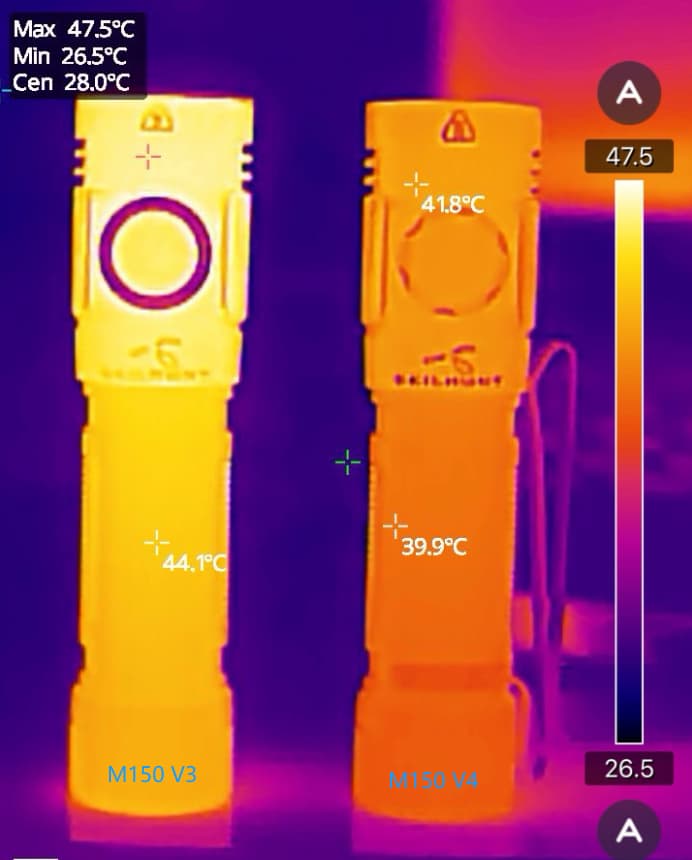
The Skilhunt M150 was one of the first lights to do a substantially better job. Using a Li-ion battery, it sent the power through a variable-output linear regulator so both battery types could have reasonable modes, and it would shut off to prevent over-discharge. Several competitors use a similar approach today, but linear regulators are inefficient; they just turn the excess voltage to heat.
The ideal solution is either to use a higher-voltage LED configuration and boost the output voltage for both battery types, or to use a driver that can both boost (increase) and buck (decrease) voltage efficiently. The Emisar D3AA is the only light on the market doing AA/14500 with a high-voltage LED configuration (three in series for ~9V), and I believe the new M150 will be the first one using the buck/boost approach (though it’s possible Zebralight has done it in the past).
Not even close. 16340s top out at 950 mAh while 14500s are up to 1500 advertised and pretty close to that tested.
Yes, by about 100 mAh.
Here are 30 1x14500 lights under 20mm in diameter. There are no 16340 lights that slim; the search offers the Fenix LD15R, but I think that’s a mistake.