

I have a challenge, can you distinguish which character set/s belongs to Japanese & Mandarin?
There are of course differences between Kanji / Hanzi but the “difficult” part is knowing which language is which simply by glancing (unless you know either 日本語 or 中文 that is).


In contrast, do you know any words that are near identical when written down between two “alphabetical” languages based on their spelling?
My guess
Top is 日本語 bottom is Mandarin
It’s actually by column rather than row in both images. Like this:
spoiler
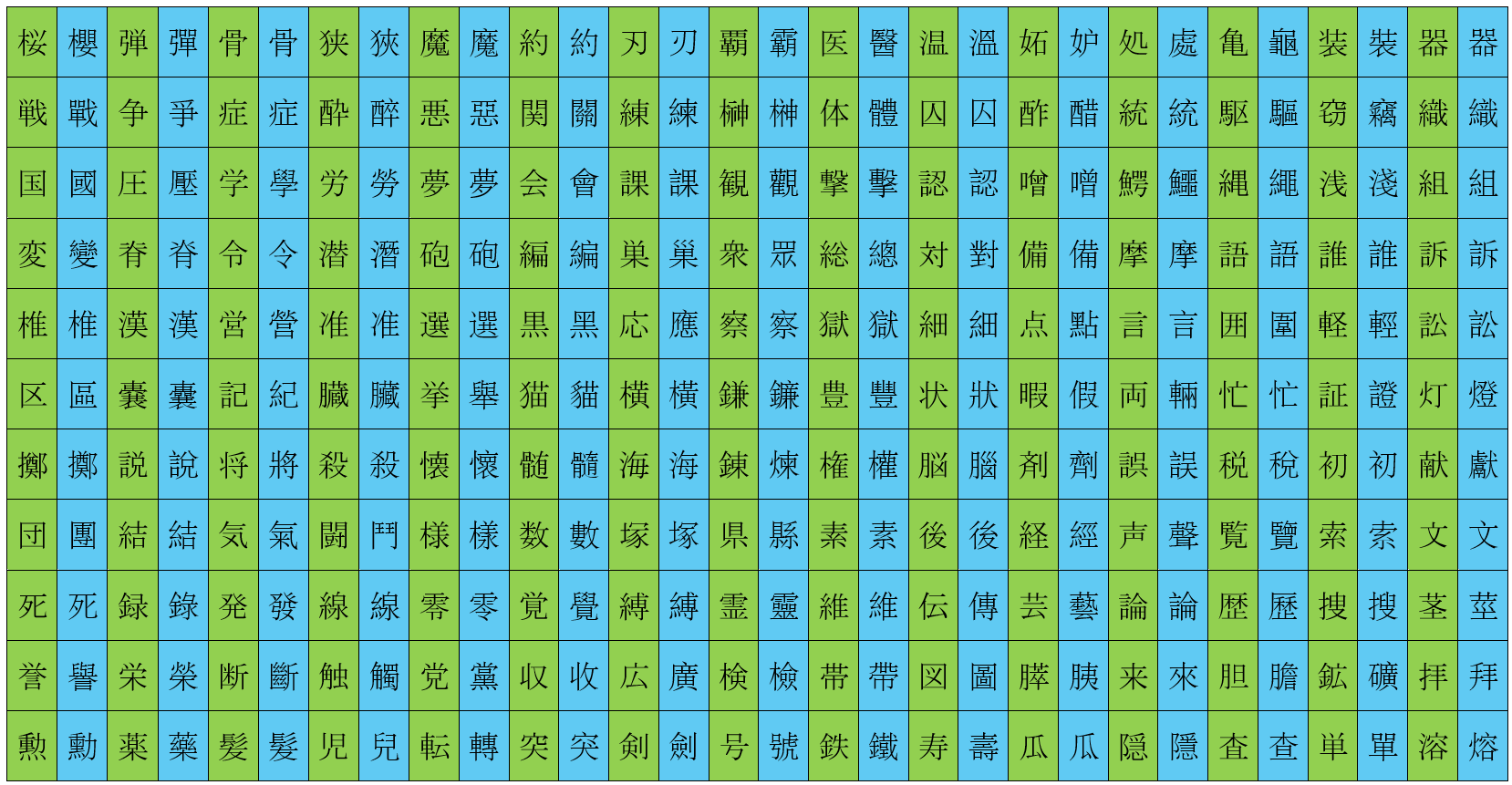
- The Green Column is written in Japanese
- The Blue Column is in Chinese (Traditional)
I only have the first image referenced, but the same principle applies on the second.
On these charts, no idea.
In real texts, it’s not that hard because Japanese text usually has kana in it. I can’t read kana, but I can recognize some of them as being kana, even if I don’t know what syllables they represent.
I’m leaning towards the first one being Japanese and the second is Chinese.
Just based on hunch, I have no experience with either.
As someone who cannot read either language, I normally go by the rule of thumb that if it has a lot of curves it is probably Japanese, otherwise I assume it is Chinese. If we can throw Korean into the mix then I just need to see one circle and that’s how I determine if it is or not. It’s not a perfect system, but I would surmise that I can guess the language well above half of the time.
Also aren’t the characters for Chinese shared across all spoken versions, if so, why did you specify Mandarin instead of just saying Chinese?
In Hong Kong, Macau (both speak majorly Cantonese), and Taiwan (mostly speaking their own flavour of Mandarin, Hokkien, and a few other ones too depending on where you are), they use traditional Chinese characters while the mainland PRC (huge pot of all sorts of dialects and other bits, but Mandarin is the standard language) is simplified, and somebody who knows one is not always able to read the other.
I can, only because I have a passing familiarity with both. I could also spot Korean characters if I saw them. although I cannot read Japanese or Mandarin or Korean, there is a definite stylistic difference between the characters and how they are represented.
I can typically tell with Western languages as well. But, again, only because I have a passing familiarity with many of them.
I can tell, but that’s because I can read both. Someone who’s never learnt either language probably can’t tell the difference between the sinographs, but could distinguish the language based on presence of hiragana, which are distinctly rounder and less dense
-
CN/JP aren’t alphabets.(excepting hiragana and katakana) they’re a logographic language, much like the Egyptian Hieroglyphs.
-
JP’s kanji stole something like 95% of its characters from CN. the only real way to tell at a glance if a sentence is JP or CN is by looking for hiragana or katakana in the sentence, as JP usually has a few of them per sentence, while CN does not.
hope this helps your linguistic endeavours! :)
Worth noting that while something like 95% taken from Chinese it was taken from traditional Chinese and then underwent it’s own simplification process independently from Chinese. This leads to a lot of subtle and sometimes huge differences between some related kanji and hanzi.
plus: sinojapanese characters often have distinct forms from their siblings in simplified or traditional japanese. so it’s possible to tell which is which without the presence of kana
But Egyptian Hieroglyphs aren’t a logographic system. They have logographic elements as well as alphabetic, syllabic and ideographic.
The kana aren’t alphabets either. They’re syllabaries. The closest they get to alphabetic are the characters that represent the single vowel sounds, A, I, O, E, U… aaand N for some reason, but those are very restricted in how and where they’re allowed to be used.
huh, the more you know.
I’ve always called them alphabets because of their phentic similarity to abcde/etc as each character represents one sound.
Alphabets are finer grained. Every alphabetic letter is either a consonant or vowel. Sometimes a letter can be one or the other depending on the specific language and context, but nonetheless, consonant or vowel.
Syllabaries pack two or more of these into a single character. Most of the kana are consonant-vowel pairings, with the exception of the six I mentioned previously, and as a result you can end up with a lot more symbols than a pure alphabet would need.
You can also go the other way into abjads, which generally only write consonants. Vowels take the form of optional marks on those consonants. Hebrew and Arabic are the best known examples of these. And you’d be less inaccurate to call those alphabets to be fair.
-
No because it is too small and my eyes aren’t that good anymore :)
Pretty sure weeb is the same in all languages
In contrast, do you know any words that are near identical when written down between two “alphabetical” languages based on their spelling?
Yes.
Idiot (English) Idiot (m) Idiote (f, French) Idiot (m) Idiotin (f, German)
Yes, also a lot of words ending in -tion exist in German, English, and French (though in German they are capitalized because they are nouns). For example “information” or “nation”.
If near identical counts too, it’s even easier because most of these same words exist in Italian with the ending -zione, Spanish with -ción, etc.
no


