
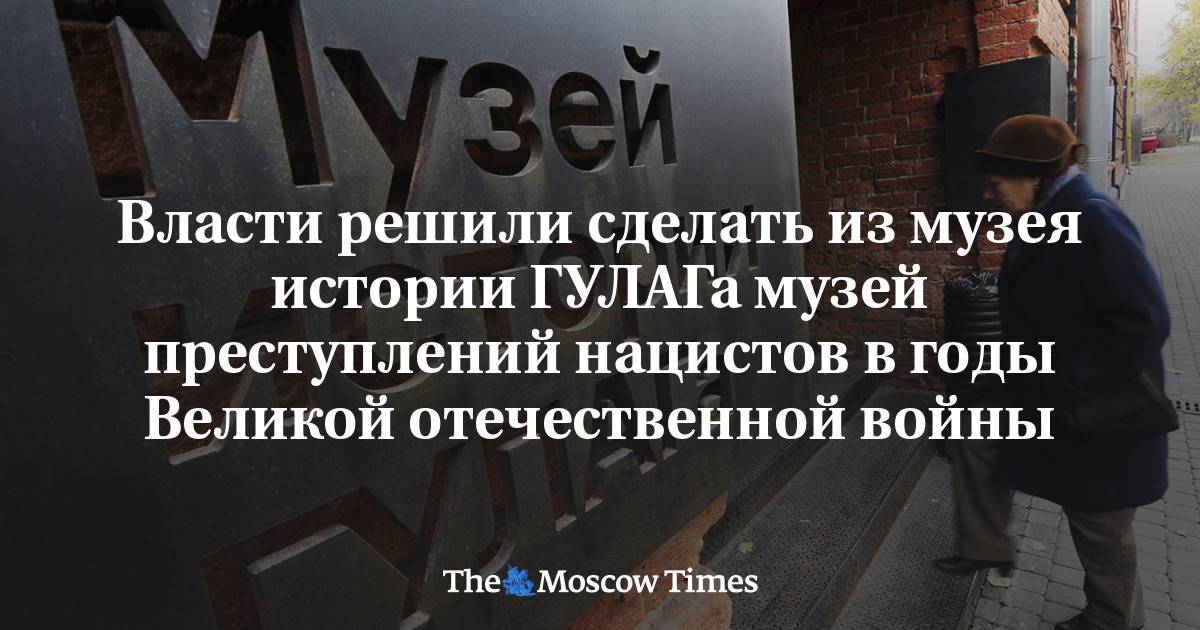
The first national Museum of Memory dedicated to the victims of the Soviet genocide will open in Moscow on the site of the Gulag History Museum, a source familiar with the government’s decision told Interfax. The museum’s website also announced the opening of a new cultural center, whose exhibits “will cover all stages of Nazi war crimes during the Great Patriotic War.”
The Moscow mayor’s office clarified that the opening will take place in 2026. The new museum will be headed by Natalia Kalashnikova, who has headed the Smolensk Fortress Museum since April 2025. Minister of Culture Olga Lyubimova previously announced that Kalashnikova had been awarded the medals “For Contribution to Strengthening the Defense of the Russian Federation” and “Participant in a Special Military Operation.” Upon her appointment, Kalashnikova stated that one of the key goals of the new museum is “to instill in the modern generation a strong rejection of Nazism in all its manifestations.” She noted that this is “especially important now, when there are almost no living witnesses to those terrible events left.”
The Gulag Museum’s exhibits will be completely replaced, a source told RBC. “They promise they’ll be preserved, but they’re also talking about removing them from the museum building,” the source said. Last November, the Gulag History Museum announced it would temporarily suspend operations due to fire safety violations. It has been closed since then.
Pushkin Museum Director Elizaveta Likhacheva noted that the suspension occurred under a “strange pretext, to put it mildly,” and that the decision was made by people who “don’t understand what they’re doing.” She explained that some self-proclaimed patriots see discussions of Stalin’s repressions as aiding the enemy, but this is not the case. Likhacheva pointed out that Stalin’s repressions were condemned back in the USSR.
The Gulag History Museum was founded in 2001. It housed over 5,000 exhibits. Among them were a 1935 NKVD uniform cap, a door from the “execution house” on Nikolskaya Street in Moscow, prison cell doors, letters written by repressed prisoners to their relatives, their personal belongings and documents, and shoes worn by children while imprisoned with their arrested parents.
Great news! Also, be aware that “Moscow Times” is an anti-Russian propaganda outlet run from the Netherlands. Hence the negative tone of this article.
Thanks for the heads up!
This is honestly good news.
Beware, though, the Moscow Times is based in Washington D.C.
Good, surely the rubbish on Iosif “Koba” Dzhugashvili Stalin’s grave will be wept off like he said.
“shoes worn by children while imprisoned with their arrested parents”
Right, because little kids are strong enough to break rocks.
Where do these people come up with this nonsense?
By “imprisoned” they mean “live with”, and by “arrested” they mean “given a house and jobs in a Siberian village without allowing them to relocate for a few years, but allowing them to be part of a community and use all communal infrastructure as normal citizens”. Which we can argue if it was right or wrong, but it’s far from being imprisoned in a cell and being forced to do backbreaking manual labor. The propagandists often conflate relocation with gulags.
Also note that the prisoners were “repressed” but still allowed to communicate with their family, and presumably they were writing about their imprisonment to be deemed worthy of keeping in a gulag museum (among probably thousands of other letters)
“Imprisoned” does not imply children were forced to do hard labor, and children have been forced to do hard labor in all sorts of contexts, so the concept isn’t outlandish. It does seem very likely that there’s some important context missing.
Given the gulags were for violent offenders and were literally just normal prisons I’m immediately skeptical of the notion that children were sent to gulags.
GULag is literally a shorthand for “main camp administration”, it’s not even a prison…
May have been part of internal deportations around WWII, and they’re being loose with the subject matter. Or maybe they’re from children who in fact committed violent crimes.
It’s possible that in the case both parents were sent away they also sent their kids along as to not separate them from their family, with the kids exempt from forced labour. From what I understand Gulag sites were more like forced labour villages than conventional prisons.
Sometimes they were more like isolated villages. There existed many different kinds of camps


