
- cross-posted to:
- [email protected]
- cross-posted to:
- [email protected]
cross-posted from: https://discuss.online/post/38877381
http://www.smbc-comics.com/comic/quantum-6
Alt text
Later they go out for a superposition of chocolate and vanilla ice cream.
Bonus panel
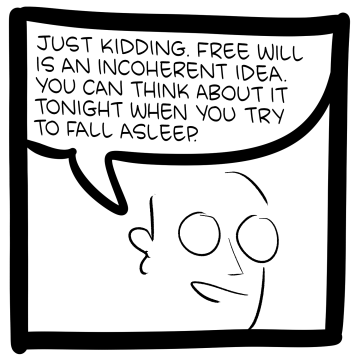
![Quantum [SMBC]](https://discuss.online/pictrs/image/12cdcf9d-eda8-4eed-b025-1eae09419199.png)
But there are no QM processes in a human body, so it also doesn’t
First of all, that’s not yet completely clear - we hardly have a complete accounting of all biological processes. But it is true that the processes we have accounted for so far are classical.
Second of all, quantum non-determinism still influences classical processes, especially chaotic ones where small shifts in initial conditions have a great effect on the long term outcome. See e.g. the weather, which is an entirely classical phenomenon, but where quantum fluctuations create a floor for how far into the future you can predict the weather even with perfect information and infinite computing power.
So quantum non-determinism allows for classical non-determinism.
Besides, you can just rely on a quantum random in everyday decisions, thus being truly random
But yeah, there might be proceses not yet accounted for
I’m pretty sure there’s a good amount of biological chemistry that relies on Quantum Mechanics so it’s unlikely the human body doesn’t have any. But there’s nothing that would impact the brain and the way we think.
Fun fact neurons are surprisingly binary, they send signals through discrete pulses with different timings. This is ironic because computer neural networks operate more analog with continuous values than real neural networks do. Because of this (mostly)discrete on or off behavior it would actually make the signal of neurons more resistant to the random noise and tiny effects of quantum mechanics.
If QM wanted to affect how we think, it would need to be deliberately amplified in a way we don’t see anywhere.