
The Extra exam asks:
E5D10 - As a conductor’s diameter increases, what is the effect on its electrical length?
HamStudy has this explanation:
From the ARRL Antenna book:
the electrical length of a linear circuit such as an antenna wire is not necessarily the same as its physical length in wavelengths or fractions of a wavelength. Rather, the electrical length is measured by the time taken for the completion of a specified phenomenon.
As the diameter increases the resistance decreases, which in effect lengthens the effective “electrical length” of the wire. Thus you could have two wires of differing physical length which are both electrically e.g. “12 wavelength” at the same frequency because the shorter one has a larger diameter.
So, to restate again: the electrical length increases as the diameter increases.
OpenHamPrep explains with (sorry, seems to block copying text):
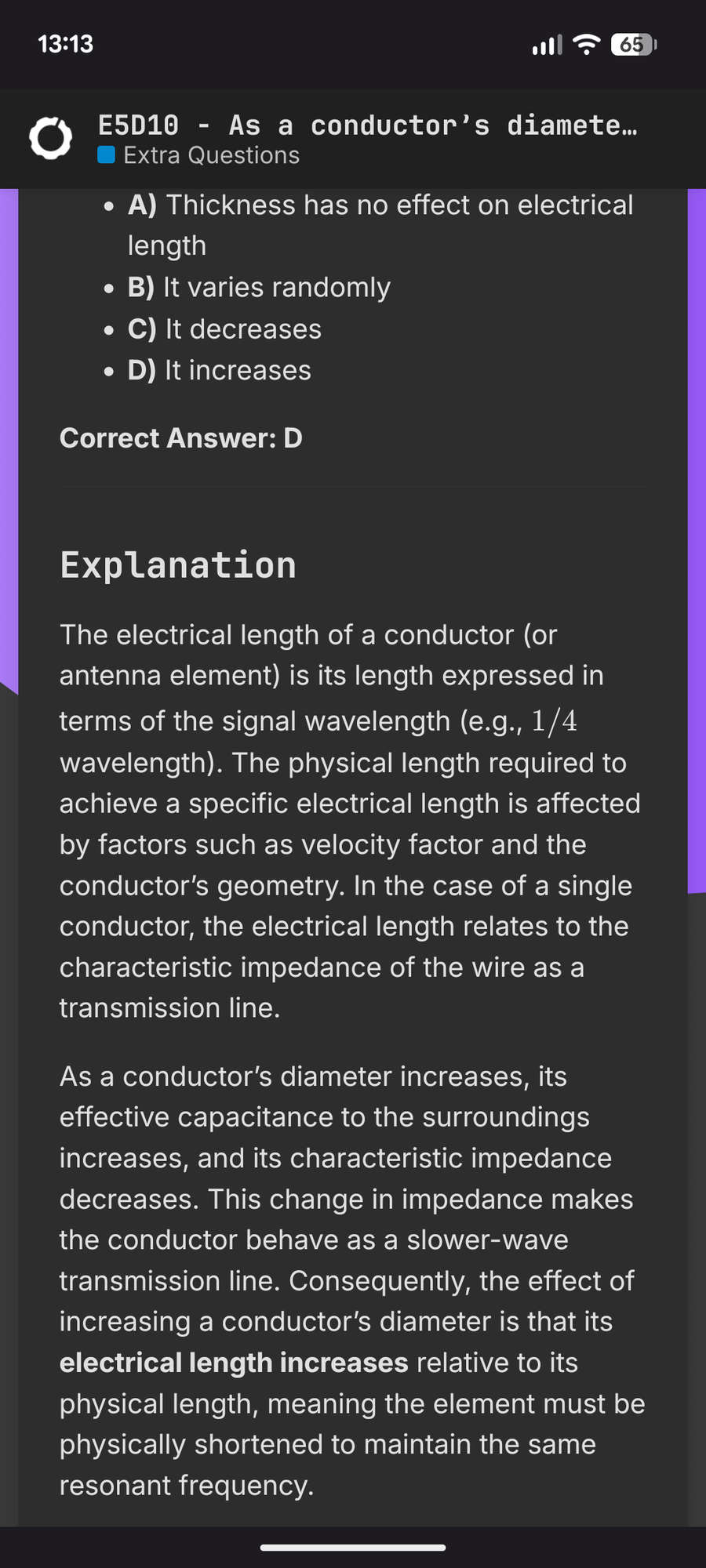
I’m having trouble internalizing the explanations though.
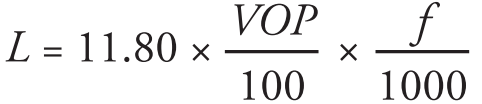
Electrical length: How does this relate to velocity factor? I’m picturing how one wavelength at a given frequency fits in the conductor. Compared to velocity factor of 1 (speed of light in a vacuum), if the wire had VF 0.8, I’m picturing that the wave in the wire would oscillate at the same rate but not get as far, so the wave would complete in a shorter physical distance. This matches an equation from picwire:
From HamStudy’s explanation, how would decreased resistance mean increased electrical length?
OpenHamPrep seems to make more sense (bigger diameter = more capacitance). But why does that reduce characteristic impedence, and why would lower impedence mean “slower wave”?