The Fixed Point Expression / Y Combinator expressed in horses:
    Y = (λ f. (λ x. f(xx))(λ x. f(xx)))
    ;; so then, give Y a horse argument with apple parameters:
    Y🐎️ = (λ f. (λ 🍎.  f(🍎🍎)) (λ 🍎. f(🍎🍎))) 🐎️   ;; [1]
        =       (λ 🍎. 🐎️(🍎🍎)) (λ 🍎. 🐎️(🍎🍎))      ;; [2]
        = 🐎️(   (λ 🍎. 🐎️(🍎🍎)) (λ 🍎. 🐎️(🍎🍎))   )  ;; [3]
        = 🐎️(Y🐎️)                                       ;; [4]
Explanation
- 1: x is 🍎, but could be anything. It’s just a function parameter nested within another.
- 2:
λfgets executed and vanishes from the left, substitutingfinternally with🐎️. This is now a new function, with left group as the function body, and right group as the function argument, despite being identical. - 3:
λ🍎gets executed and vanishes from the left, substituting🍎with(λ 🍎. 🐎️(🍎🍎)) - 4: Everything within the main brackets at [3] has been seen before at [1], but with f being 🐎. Thus we have bred a new horse. We can breed infinite horses this way
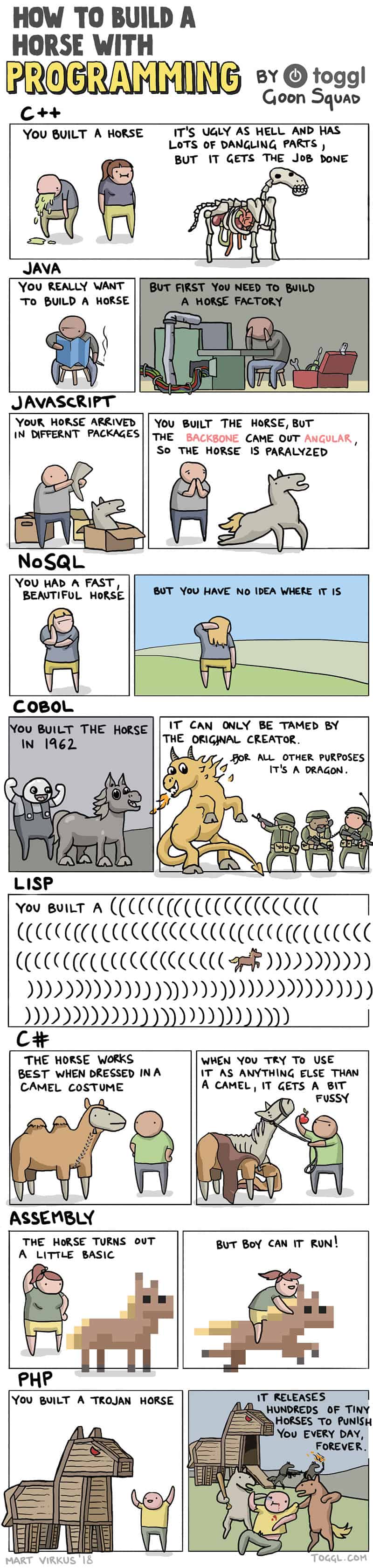
The LISP parentheses are not equally balanced. There are more ( than ).
Oh god, I’m getting PTSD. So many parentheses
Exactly 6 more.
)))))) There, the horse is contained now.
You thought so, but there was a teleporter
Shout-outs to enclose.horse!
But notice that lisp was the only one where you actually built a horse.
Also assembly. And the dangling parts.
ruby: you built a horse that builds a horse to build your horse. your barn is too small. it crashes. everyone is dead.
Python:
from horses import Horse

my_horse = Horse(color="brown")
There. Done.
You built a horse in Python. There’s too much space between you and the horse so it dies.
I’ll just instantiate a new one.
Or you accidentally used spaces instead of a tab on one line
Your horse is now an upside-down zebra
In Nim:
import horses let my_horse = Horse(color: "brown")horseswas last released in 2024, and can only run on python up to 3.12.horsesdepends oniron-making, that is up to date. That means the current version ofiron-makingdepends on python >= 3.14, and that all the versions prior to 2025 were taken offline due to a CVE where if you run the library as root in a web backend that uses themake_nailfunction, people can open your barn doors without authorization when inside it.thanks, I hate it
and also the most recent
horsesrelease on pypi includes a crypto miner and credential stealer.I cannot up vote this enough.
C: You build a horse. Well, it’s not really a horse, but it can do almost all the essential horse-things. It’s incredibly fast and compact. Oh, and now someone else owns it.
you could say that it aged well
As a non-programmer, TIL Java and JavaScript are two different languages.
Person1: I built a script in Java.
Person2: So Javascript?
Person 1: NO!
When JS was being developed, Java was all the rage and it merely was riding it’s coattails. At the time of its creation it was nothing like Java either.
the only thing they have in common is how insufferable it is to develop with them.

Looks big enough to me.
Well, this is the original as it gets, direct from the source.
All right. Sorry if that came across the wrong way: I wasn’t actually trying to complain, I just used the meme because I noticed the low resolution. I don’t know if I’m getting too old for this crap, but back in the day, that meme used to pop up all the time as a response to low-resolution images. ^^
The resolution is great on my end. That might be where the confusion was
On the boost app there’s a tiny HD button you can click that should sharpen things up a bit.
Nah, that’s ok. Though you have to click on the image for full resolution. On Lemmy it shows small for some reason.
Oh, didn’t realize that, thank you!
No problem!

This might be a client issue, eg: when images are too big, Thunder pixelate 'em


It is indeed, thank you!
Good to know. 🙏
Is it a dig against C# only being good when using it from F#, i.e. OCaml for .Net or am I overthinking this?
I don’t know. I thought it was a dig with certain C# dev products trying to mimic how other technologies behave, like WebForms.
And here I am glad that I try to avoid phpMyAdmin too, whenever possible.
Rust builds a unicorn
ho-rs
It is perfect and will run for a million years.
Dodges all traps and jumps over all ditches whether you see them or not.
But you are already too old to ride it.
In Horse64:
import horses from horses.horse64.org

func main {
    var my_horse = horses.Horse(color="brown")
}
And in Horse64 Root:
import horses from horses.horse64.org func main -> bool { var my_horse <- horses.Horse my_horse.init("brown") if failed(my_horse.init) { return no } defer my_horse.destroy() my_horse.run() if failed(my_horse.run) { my_horse.stop() return no } my_horse.stop() if failed(my_horse.stop) { return no } my_horse.eat("hay") if failed(my_horse.eat) { return no } return yes }Ctrl-F “rust” - > 0 matches
I sense a pertubance in the force
Well duh, Ctrl f doesn’t work on pictures!
…yet. Then again, that’s literally what “alt” on images is for.
Needs a python horse in there.
Probably something about “why build a horse when you can just
import horse from field?”“The horse turns out perfectly average, but boy it can’t run”
But it still gets there faster than all the other horses on account of how easy it was to implement.
Sadly, it gets so long to go from point A from B that you wish you made the horse in something else…
It was so easy to make the first horse that you decide your field is big enough for three more horses, but somehow the second horse says it needs three more pastures to function properly.
horse()But it’s built 10 years ago using conda so the installation process is more complicated than building a new horse.
from field import horse*Well don’t I look like a grade-A moron now?