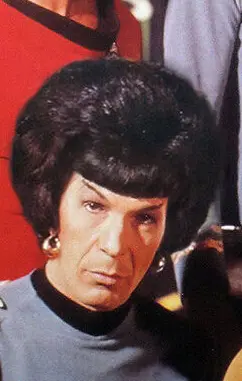

Excerpt from ‘Star Trek: The Official Guide to the Animated Series’
It also probably doesn’t help that progress moves quickly. When the Kelvin films were released, gay marriage was not Federally legalised in the US. That only happened about two years before Discovery first aired.
Though I don’t know if checking boxes is entirely true either. In my opinion, the bigger issue seems to be that a lot of them have no idea what they want to be, and while that might be fine for something episodic, that’s not really feasible for more modern serialised shows.
Discovery gets a little bit of a pass from its first two seasons being a production disaster, with the show runners getting fired or kicked out for a variety of reasons, but it never really settled into what it wanted to be either. All of its seasons are completely different to each other.
Picard has a similar issue, where the overarching plot kept changing per season. First you had the synth plot, then the ex-Borg abuse plot, and then the actual Borg plot, which ended up dragging the show all over the place, because it had serial hooks that made you expect a continuation between seasons, which then weren’t followed up with.
It rather reads like the entire premise is to make Star Trek and that’s all there is, with nothing more behind it.
On the social side, Star Trek is a huge cash cow now, so executives probably aren’t that keen on anything that pushes as hard and risks tarnishing the brand, but that’s been a trend since TOS. Most of the sequel spin-offs after its big success haven’t had that almost blatant progressiveness, where they were really pushing social boundaries.
I do wonder if Star Trek could also benefit from stirring the formula up a bit. The 32nd century could have been great for that, but unfortunately wasn’t taken as a route. Whether advertently or inadvertently, since TNG, a lot of the issues have gradually shifted from being in the alien planets being visited, to flaws within the Federation itself.
Both TNG and Voyager show extensive bias within the Federation for organic humanoids for the most part, and that was reinforced a bit with Picard. DS9 had a splinter group of people in the Federation who thought they were too soft, and someone needed to do the hard dirty work to make the Federation a success.
A show that digs into that explicitly could have a decent amount of bones in it. What does a society that sees itself as a moral utopia do when they find out that they aren’t? Can the Federation survive without the dirty work? Does the Federation lionise its core members too much, including venerating their own heroes at the expense of others? The entire genetic ban came about because Earth misused it in history, and Cochrane is credited as the inventor of warp drive, even though the Vulcans had it for much longer than Earth has been on the galactic stage. Who invented the Vulcan warp drive?
Or on that topic, how does the Federation deal with technological changes, or something that ends up pitting them at disadvantage, that can’t be quickly resolved? Warp drive putting holes in the universe was done behind the scenes, but what if it wasn’t, and the Federation was stuck between deliberately holding themselves back, or risking their quadrant of space? Or if warp drive started becoming an obsoleted technology. As far as we know, it’s a technology whose basic design and operation have barely changed since the 21st century. It’s been 300 years. A lot of the alternatives aren’t better, or have serious drawbacks, but there’s an open question of what if something was simply genuinely better, and a lot of conflict from that, which could make for something quite compelling.
Leonard Nimoy was by all accounts a real one. Just a hell of a mensch.
TIL that mensch is an actual term in the english language.
It’s a Yiddish term.
It’s also the German word for human.
I’m German myself ;) But in this context (great human being) it’s not used here as a single word, perhaps “eine Seele von Mensch sein” (to be a good-hearted soul).
Thank God they returned as Uhura and Sulu respectively. Just imagine if they cross cast and had Takei do Uhura.
If AI wasn’t so horrible for the environment, this would have been a pretty funny thing to have it simulate.
ohh myyy
It’s only logical.
If the point of this is to draw the false conclusion that TOS was checking boxes as much as modern Trek, it’s simpleminded and wrong. TOS was acknowledging social issues back in the pre-metrics era, before the media industry even drew up the checklist. Back In the '60s it was Roddenberry and a few others wanting the show to do some responsible things. Today the “thought” process aims to identify social cohorts that generate enough buzz among consumers to be worth pandering to.
And Rod Serling was doing the same thing starting in the late 50s with Twilight Zone, using fantasy and science fiction to discuss subjects that TV never would have put on the air have they been shown in a realistic context.
If I’m understanding your post correctly, you’re saying that ‘60s Trek had representation because it was the right thing to do, while modern Trek has it because it believes it is more profitable. That leaves me with two death-of-the-author type questions:
- How do you know the motivations behind these decisions?
- If representation is a good thing for the show to have, why does the motivation behind its inclusion matter?
- Roddenberry’s desire to include social commentary in TOS has been discussed for decades and is well known.
- Representation that cares about the issues tends to be more honest and true than the tokenism and hand-puppet waving that more typically come from targeting a consumer audience.
I never said I doubted Roddenberry’s intentions. I don’t particularly doubt the modern team’s, either, though.
Representation that cares about the issues tends to be more honest and true than the tokenism and hand-puppet waving that more typically come from targeting a consumer audience.
That sounds fair to say in general, but it’s not very specific. Which characters in modern Trek would you say are token minorities?
Regarding point 1, Roddenberry was indeed very open about his desire to make sure that when people watched Trek, they saw a version of the future where things were more egalitarian. He wanted a woman to the first officer on the ship, even though he also had Pike voice some consternation about having a woman on the bridge regarding yeoman Colt. He wanted people of colour on the ship. During the height of the Cold War, he wanted a proud Russian character on the ship, and even made up a story about being a Russian magazine article criticizing the lack of representation. He wanted people of colour on the ship. According to George Takei, when he tried to convince Roddenberry to include gay representation, Gene said that he wanted to, but couldn’t push for that with the studio. TOS famously had the first scripted interracial kiss in a North American television show.
As you alluded, even if we recognize that some of Roddenberry’s motivations were money and ratings oriented – like having Chekov’s hair be styled like the Monkees’ to appeal to a younger demographic, or his introducing the Vulcan IDIC he could sell merch of it – we also have to acknowledge that he was dedicated to portraying that egalitarian future as much as he could given the constraints of the era.
But how do you know the motivations of the people making those decisions today?
If your question is sincere you should do a little searching on Hollywood or Show Biz pandering to the loudest voices on social media. There are tons of stories from entertainment celebrities, writers and other insiders, attesting to how executive decisions respond when social media deifies or demonizes something. I support giving people the benefit of the doubt, but in this case you could just as well ask how we know Trump doesn’t have a secret plan for an egalitarian utopia.
But how do you know the motivations of the people making those decisions today?
You can just look at the writing.
Sometimes on shows and movies they have fan service references to things from the franchise’s past. You can spot that, right? They show you the thing, make sure it’s center frame to be sure that the audience knows you have that thing they know in the show. But there’s no point to it in terms of the plot, it’s solely there to say to the audience “look we have this thing you like in the show!”
Many shows do the same thing but with political issues. They mention it, but they don’t bother to have a plotline about it, or have it integrated into the story line. It’s just there so they get credit for mentioning an issue exists. They don’t want to actually discuss an issue too deeply, that would be too controversial.
Actual social commentary is very rare in TV shows and movies now. What we have now is social fan-service. Just references to issues, not actually taking a risk and doing anything meaningful with it.
I took it more as demonstrating to the weirdos that have recently been up in arms that Star Trek became too “woke” that they’re idiots who’ve been missing what’s right in front of them the whole time. I don’t even like Star Trek (No knock to those who do, but I grew up around a fair number of committed Trekkies, and none of their “Oh, you’ll see if you watch this episode!” worked. Not saying it’s bad, just not for me.), and I’ve known for ages it had plenty of progressive elements. I read this the same as people poking fun at Republicans who listen to Rage Against the Machine and unironically think they aren’t parts of the machine being raged against.
The “weirdos” (which include Patrick Stewart and other alums) aren’t objecting to the content but to the preachy, heavy-handed delivery. Roddenberry commented on the ridiculousness of racism with two characters hating each other for being the wrong color on the wrong side. The Picard s2 writers had characters walk around present-day LA saying things like, “There’s so much the social injustice!” The complaint about modern Trek is that it tries too hard to be “woke” and not hard enough to be good science fiction.
It’s so crazy how the difference between “preached” and “commented” is based on your specific opinion of where social progress should have stopped 🤔
As opposed to characters walking around modern day San Francisco discussing environmentalist taking points?
Please. Trek has never been subtle. Anyone accusing Trek of “trying to be too woke” was never paying attention in the first place.
No no no it’s simple see:
Black lady serving on the bridge crew = “social commentary”
Black lady leading the bridge crew = “preachy heavy handed delivery trying too hard to be woke”
That’s a potentially valid complaint, I was thinking more of people just complaining that Star Trek es bad just because it’s become too woke and liberal, though. People like my father will just moan, “I don’t know why they have to make it political with this stuff, Star Trek never used to do that.” if he sees an episode with morn than one black character in it. There are some real idiots out there.
There are idiots out there, but also a lot of people we assume are idiots because for some reason we want to draw the worst possible conclusion and define them as The Enemy.
imo the best thing that modern trek has going for it is the fact that it’s continued in the spirit of the original and sought to represent people otherwise largely ignored on the mainstream cultural landscape. berman-era trek actors would have supported lgbt+ story lines except it had a berman-shaped problem: berman. one of the reasons ds9 is so beloved is because it found creative ways to get around this. i fear with the takeover of skydance this may be wittled away and we’ll be left with nothing but shitty action-adventure copraganda à la paramount but put it in space.

Representation is not pandering.
And yet for some reason the word “tokenism” exists.
Ah a clever and biting retort to be sure! A short and sweet dagger to the heart of the argument. Your college debate team is clearly very lucky to have someone like you among their ranks! However, I warn you, the fediverse, my friend, is the biggest of the big leagues, and such concise witticisms and stinging flashes of showmanship will not suffice to pull your seemingly iron clad observation across the finish line! Tokenism is not representation.
I do agree with you that the modern iterations of Trek are not nearly as progressive relative to our time as TOS was in the 60s.
Well said
Arf arf

Never heard that. Thanks for posting.