Artificial-intelligence systems such as large language models (LLMs) can exhibit behaviour that seems strikingly intelligent. This has led many people, including some experts, to wonder whether these systems could have some form of consciousness — the capacity for subjective experience. However, we think that existing AI systems are not conscious, and that, along current trajectories of development, they are not likely to become conscious. Greater clarity about whether AI could become consciousness will be crucial as society grapples with the challenges posed by this increasingly powerful technology.
It’s a computer program and some data - nothing more.
I’ll happily treat it anyway I see fit at the time - including powering it off without loosing any sleep over it.
ehh. computers are just math machines. merely doing math and representing it cannot just make a consciousness pop up out of nowhere. similarly, millions of abacuses being manually moved in specific ways cannot be conscious either. i dont even know how this is a topic of debate.
And yet atoms are just following chemistry and cannot just make a consciousness pop out of nowhere.
Oh wait it can.
And all human brains are doing is firing neural impulses.
It’s incredibly reductionist to reject AI consciousness simply on the basis that it’s software. To be clear I don’t think LLMs are conscious but that’s not the same as saying that an AI could never be conscious.
I really don’t think the neuron is all that complicated, at least as far as we use them for thinking.
It isn’t, but that’s not how LLMs are built. If you want to go that route, you can read Jeff Hawkins 1000 brains.
The short and sweet is he argues you can’t get artificial general intelligence the way we make LLMs, you need to basically create neurons and let them connect and interact in novel ways.
Linear algebra in neural networks isn’t really that, despite the name.
~you need to basically create neurons and let them connect and interact in novel ways.
To solve that you simply need to give the ai the ability to retrain itself or set fixed “memories” to handle situations it finds the truth to
Correct. And I believe it’s happening, right now, behind closed doors.
There’s nothing stopping it from happening. The technology is all there. It would be trivially easy with the right hardware. I’d do it myself if I didn’t want to be the human responsible for releasing the genie from the bottle. Let Pandora’s box stay closed as long as possible - I’m not opening it. But someone, somewhere, surely is.
Easier said than done. That’s kind of the purpose of an individual neuron approach I think. I don’t see a way that a bulk retrain is reasonable because it takes a long time, uses a lot of resources, and also requires you to have your whole training corpus handy all the time. Your brain is not doing a wholesale rewrite for every new memory, and new memories often chain together. I don’t think you can just say “ah well, let’s update the RAG or do another supervised fine tune with LoRA or something”. At present, we just don’t really have the machinery in the models to do simultaneous learning, inference, and forward planning.
This is only a matter of resources, and these unthinkably wealthy corporations have those resources.
Linear algebra + sigmoids are enough to approximate any function from R to R; in particular, a small set of a few layers of LLM neurons can connect and interact in pretty novel ways. There are some things they can’t do, and those things aren’t computable. If our brains can do non-computable things, then our brains are super-turing (and this, given the evidence, seems pretty unlikely right?).
I’m not a neurologist or a philosopher so I think this may not be something I can speak intelligently about, but it seems to me that the question doesn’t really live in the function approximation, but in the gaps. Doing a single train of thought is the easy part. I think what you need is an “always online” feature to keep thinking and some way to be stateful (make memories) without constantly retraining the whole network or whole sets of layers.
This is, I think, the benefit of the parallelism and asynchrony of the “individual neuron” discussed in the book.
(book? The linked article is like 4 pages. References are somewhat larger, but nothing over 60 afaict?)
They claim that silicon is essentially incapable of doing what is needed; if you disagree with this, then computationally everything you can build with a circuit board + SSD + RAM you can build with an LLM with a deep layer or 7. In particular, you can do online learning of a sort.
I note that wasps and some beetles don’t seem to have memory whatsoever, and plasticity seems awfully low. The authors, and I think most people, would say they are probably a little conscious.
https://www.goodreads.com/book/show/54503521-a-thousand-brains
That book, not the article. I can’t recall if it makes a convincing argument about consciousness, but it has a lot to say about general intelligence. I thought the neuroscience parts were a little cumbersome, but still worth the read.
Sounds to me like you just need a context window with memories that self prune based on the dynamic context window of the model. That’s what we do. We forget things, and when they’re remembered we can access the “biological database” of associated memories on the fly. Because the associated information isn’t deleted, only the short term memory from being included in the context window of each update of our own neural networks. Some people have greater context windows, and see therefore seen as smarter, because they can access more information and include it in the processing of each moment in time.
There’s zero reason a digital representation of this system could not do the same thing. No matter how much I’m ridiculed for daring to suggest it 😅
We can build different kinds of machines.
Painful watching people who have clearly never bothered to read even the shortest excerpt of philosophy try to have a philosophical discussion
If we wanted to compare LLMs to actual intelligence, we might say it’s like the voice in your head. It doesn’t solve math problems, or express emotions as art, or plan your motion to climb a ladder; it merely surfaces these things in a way that is observable across your conscious mind and communicable to others.
Some people don’t know that their consciousness is more complicated than a linear thread of words, so the idea that some other linear thread of words might be conscious is sincerely plausible to them.
Ok, in what way does this prove the existence or nonexistence of the non-linear-thread-of-words consciousness in any entity?
I don’t think it proves anything, and I don’t think it even set out to prove anything. I think it is trying to establish bounds on the problem by distinguishing between intelligence and consciousness.
But if you’re specifically interrogating my comment, the answer is pretty simple: an LLM mimics intelligence, but not consciousness; a fruit fly is conscious but not intelligent, and achieves this without an inner monologue.
Those who think that generative AI is ‘conscious’ don’t understand that it can only do what it is trained on. It can produce impressive outputs only because it fuses together data taken without permission from millions of people, not because it’s intelligent or conscious in its own right.
Case in point have they ever turned on a model and left it for it to, on its own, decide “wait what’s going on, who am I, what/where am I?”. And start independently exploring?
Highly doubt it. If so, we’re cooked
I suspect cooked…
The funniest exercise is to ask any LLM for a short story and they all come up with Elias the lighthouse keeper visited by Maria or some variation on that theme. That’s not creative or conscious.
I actually agree with you about AI, but I’m sure if you asked the average person to come up with a short story multiple times you would also see a pattern in names and themes. They’re probably going with names in their own language, or if they read fantasy and are influenced by that they may use names that seem stereotypically fantasy oriented. I don’t think AI is conscious, but just because something has tendencies doesn’t mean it’s not creative or conscious.
Twins separated at birth sometimes have really eerie parallels in their lives. I think people put a bit too much emphasis on consciousness as a driver of individuality and choice.
Not only that, they only act when directed. There’s zero idle “thought” when they’re not actively performing a task.
We would be the same if our senses only updated when someone allowed them to. But we have real time input. There’s nothing stopping AI from having real time input, apart from simple system design decision.
You are able to think even when there’s no other senses giving input. LLMs have no idle processing. No random stray cycles about what it previously worked on.
Yes, but the state of the neural network can be it’s own input, allowing continuity from moment to moment, based on the number of refreshes we allow it or the hardware is capable of making. That’s what we’re doing when we think, we’re dwelling on the state of our current moment - in this sense, they would also think even when there’s no other senses giving input.
This is strictly false, generalization in LLMs is well documented.
It’s also not relevant. Read the first point in the article: intelligence != consciousness. Individual ants, bats, and fish do not do anything very creative (certainly less creative than gpt-2), yet they are probably all conscious.
By identifying"memories" they can include the information in the context of the next update - this is akin to our short term memory. Make it self pruning, where the data is saved locally but not included in the next context, and it acts the same as own memory system.
Also an LLM only produces output when it is prompted to do so. Between prompts it’s not sitting there - waiting, wondering about the meaning of life, getting bored - until you prompt it again. It’s basically dead.
I like to compare llms to a Galton Board. Instead of the regular layout of pins someone added or removed pins so the marbles on the bottom fall into nice to look patterns.
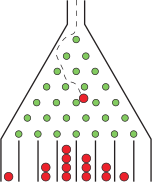
Also an LLM only produces output when it is prompted to do so.
Why is this a good measure of consciousness?
If continuity isn’t relevant for qualia, then LLMs could have perpetually incomplete perception like the edge of the image drawn on a CRT screen when captured at high frame rates. You never see a complete picture even if it’s technically represented.
It is certainly interesting to think about what your conscious experience would be like if it changed every brain cycle instead of being a continuous stream of information
There’s nothing from stopping someone from wiring a camera, sensors, and motivators to a collection of neural networks, and have one parent neural network control them all. That would approximate the hemispheres of our brains.
It would not come remotely close to approximating our brains, in any way. This exhibits a lack of understanding of both LLMs and how our brains function.
That’s a valid opinion, but it is the opposite of mine. Agree to amicably disagree?
I’d like to know what evidence you have to support your position. I’m sure true artificial intelligence is theoretically possible but existing LLMs and other models cannot be that, not while maintaining a definition of intelligence that at all implies “like us” which is the only really useful definition.
Just insight and intuition gained from twelve years of post graduate study at Universities, including a MSc in Machine Learning.
I’m not sure “like us” is something that is quantifiable. I’m of the belief that treating we meat automations as anything special is hubris. We’re finite state machines, acting on information input from our senses, making decisions, and outputting information in the form of activating biological apparatus. Swap physical for digital, and LLMs are indeed capable of aping all of our behavior.
That’s not the reason, we’re in the same boat when it comes to knowledge in many ways.
But we don’t even know what consciousness is so it’s a waste of time reading the “3 reasons (*potential)” IMO.
Nobody can even agree on a concrete definition of consciousness so I’m not going to bother reading these ‘reasons’.
Wait are you implying you think LLMs could be conscious? Fuckin hell we’re cooked.
Define ‘conscious’.
Sapient, salient, sentient, self-aware. An LLM can’t be any of those things any more than an abacus can be. But I’m sure you’re just gonna devolve into philosophical rhetoric about nature of consciousness that still isn’t actually relevant but that will allow you to apply it to your misunderstanding of how LLMs function. This thread is apparently an AI bro brigade and I’m not interested in engaging with a bad faith group.
you seem more bad faith than the group
Says the AI bro. Seriously your comment history is public, your whole account just glazes AI.
Since you want to look at my comment history, consider actually reading next time. I am as far from an AI bro as you can be, but it’s easier for you to think so instead of considering arguments.
Read the thread. Everyone defending the idea that LLMs can be conscious are spiraling off into theory of mind that isn’t actually relevant or applicable. One dude’s whole argument is based off his totally unproven assumption that consciousness is a property of the physical structure of brains which is both limited and misguided. There are no serious arguments here, just philosophizing.
I downvoted this when you first posted it but I came back to find it has 50-something upvotes, so I feel compelled to respond.
It’s obvious that you haven’t read the article since literally the second fucking sentence defines exactly what the author means by “consciousness”: “the capacity for subjective experience.”
So, your comment is completely useless. And it’s mostly wrong.
Nobody can even agree on a concrete definition of consciousness
Not only is that false, it doesn’t make logical sense…
Lots of people agree on a different definitions of consciousness.
And most of the ones educated on the topic all agree on the same thing.
A bunch of people who never bothered to try and learn about something not understanding it, doesn’t mean anything.
That’s because there’s different levels of such a thing. Way too many people use the term “sentient” (even me) and yet that’s not even what AGI is aiming for. “Sapient” is the right word. And I doubt there’s solid consensus on what and how it occurs within the fields of experts.
But I’m not an expert, so I wouldn’t pretend to know. I have seen debates between people who do know more, and the fact there’s debates concludes it’s not settled at all.
People debate about the earth being flat, not a good metric to determined what is “settled”
The debate on consciousness are on par with Copenhagen interpretation versus pilot wave versus multiple words - except the underlying theory they’re trying to describe is also not well defined
We can only practically describe subsets of what’s required for some basic functions, and we can describe a bunch of chemistry, some brain activation patterns, etc. But nobody can tie that together to why we feel what we feel (and some don’t agree that qualia is real, that perception itself is an illusion)
And most of the ones educated on the topic all agree on the same thing.
Source?
Not only is that false, it doesn’t make logical sense…
Argument by assertion and you haven’t proven the assertion
Lots of people agree on a different definitions of consciousness.
Lots of people can’t agree on a different definition. Is there a different definitions then by it’s very nature people do not agree.
Nobody can even agree on a concrete definition of consciousness
I agree with myself…
Nobody can ever agree on _____
Isn’t a logically sound statement.
Not everyone can agree on _____
Is logical, but means nothing because a single flat earther means we can’t all agree the earth is round
I thought that was obvious…
Lots of people can’t agree on a different definition. Is there a different definitions then by it’s very nature people do not agree.
But you clearly don’t understand the difference…
It’s really not difficult. You made a statement that stated that you believe that there is consensus, so presumably that means that you know where that consensus exists, therefore provide a link to it. If you cannot then you cannot make the assertion that consensus exists, because by definition it doesn’t.
Your entire argument rests on the basic idea that there is a scientific definition for consciousness and we have a test for if something is conscious or not. There is no test because there is no consensus. It is not possible for you to prove through scientific rigor that you are conscious, and presumably you’re human. So how can they possibly be consensus on something as contentious as artificial intelligence?
Please read the article. It contradicts you, and argues that LLMs aren’t consciousness cause they can think of, count em, 3 niche theories that the authors like which are impossible for anything not made of meat to qualify for.
Just because we don’t know what it is doesn’t mean we can’t know what it isn’t.
Current AI is not conscious because it’s an
.exefile and a big database. Why do we need to always debate this?Your “consciousness” is just an ephemeral electrical process in the jello of your brain that can’t even reinitialize from cold. Why is that your holdup?
(Also now true of fruit flies! So feel free to kill them all, they have no experiences.)
That is a pretty huge misunderstanding of what the fruit fly thing was. Researchers mapped how many neurons they had and which interacted with which others, but not the strength of those interactions or even how the interactions worked. People on the internet used this blank mapping as the “structure” for existing ML technologies and trained them to do random things. No actual fruit flies were simulated, and we are still a long long way from actually attempting that.
Thank you! Tho perhaps to the spirit of my point: nobody is seriously claiming we can’t simulate this with a quantum computer someday, right?
We really don’t know enough about how brains work or how quantum computers will scale to even speculate on that
LOL. “EXE file and a big database.”. That’s the most gross oversimplification I’ve seen since life was described as “bags of meat that do random things.”
If AGI ever happens, it will be an executable (or a number of executables) with something closely resembling a database, because that’s the only way an architecture built on symbolic logic can operate.
Then there will never be AGI.
because you can’t prove that it is not conscious
just like you can not prove that a person is conscious
There’s an accepted way to kill or not kill a person based on the way the brain reacts when you zap it with electricity but that doesn’t prove consciousness
Reasons given:
- Intelligence is not consciousness
- Silicon brains are not made of meat
- Consciousness requires meat (and/or a particular winding of neurons)
Those sound like arbitrary assertions to me, which no backing apart from the authors personal beliefs
They cite sources; but I find them more of the same.
And point 3, as far as I can tell from this argument, isn’t serious. It merely asserts that there are some models of consciousness that would prevent us from using the term for AI. But the models aren’t ‘popular’, ‘widespread’, or justified at all afaict. It’s just that the author has a pet causal mechanism they made up. It’s also pretty abelist by my read.
integrated information theory (IIT), starts from the essential properties of consciousness — those that are true of every experience we can have. For instance, we experience every visual scene as a single, integrated whole: its left and right side, colours and shapes are bound together to make the experience what it is.
In other words, if you’ve got any sort of trouble integrating a visual scene, then you aren’t conscious. Sure.
Point 1 is surely true, but also not helpful. The most persuasive example inside is the classic:
Similar to an LLM, AlphaFold is a powerful neural network running on silicon hardware. Yet almost nobody worries that it might be conscious. That’s because AlphaFold predicts protein structures, whereas LLMs ‘talk’ to us.
You can read this both ways…
Thanks, could only see half of it because of paywall.
These are, to be frank, really weak. They say on point 2:
Computational functionalism … is popular among some scientists and philosophers, too, but we think it is fatally flawed because brains are not — or at least not just — computers that are made of meat.
One main reason is that it is impossible to separate what biological brains do — their functional organization — from what they are — their material substrate. In other words, there is no distinct separation between the mind and living tissue in the human brain, as there is between software and hardware in a digital computer.
Restating clearly: Ghosts are real. The mitochondria is not only the powerhouse of the cell, it also gives you mystic powers.
Really? The source they site for this point features the lovely assumption “consciousness is unique to biological life”. From this axiom, I see how the conclusion follows, but I don’t see why we should believe this axiom. We can do physics simulations of every atom in a fruit fly on a computer…
This analysis is correct but I have a minor quibble: The simulated fruit fly brain is not a complete simulation of the biological processes, or even all the neuronal connections, of the actual fly’s brain.
@Feathercrown
@artISAn #consciousness #AI #brain #neuroscience #computer #functionalismEven a “complete simulation” of a fruit fly brain would be no more than an approximation. I think you mean “emulation” and I agree.
The simple reason is that we do not know scientifically all of necessary and sufficient functional mechanisms of consciousness, nor consciousness’s functional role in “intelligence” (which we also have trouble describing). If, and only if we we did, we would (given the right tools) be able to replicate it functionally (in principle) using computation.
Specifically, I refer to a Universal Turing Machine (UTM) and the Church-Turing Thesis (the foundational principle of all computer science). EVEN THEN, there are computational problems that cannot be proved to be solvable by a UTM (e.g., the Halting Problem) and we don’t know what, if any role they play in consciousness.
Bottom line for me: we are going to need a revolution in each of the sciences of psychoneurophysics, mathematical logic, and theory of computation before we can begin to talk about replicating consciousness in a machine.
emulation is a better word; adopted.
I don’t see why we would necessarily need to understand consciousness to create it. There is no evidence that nature understands the consciousnesses it has created. In fact a human can create a new consciousness in about 9 months without knowing any theory.
The question in my mind is, how could we possibly tell we’ve succeeded? We can’t even say for sure that anyone other than ourselves is conscious.
@Feathercrown Maybe all you need are the right ingredients? I don’t think so. There must be a recipe. Human ontogenesis proceeds according to a process specified in our genes, modified a bit by the developmental environment. We don’t fully understand that process completely (AFIK) but there are no intrinsic obstacles. #Mind emerges at some point.
You are right about the question of recognizing consciousness. People are predisposed to attribute life, intentionality, and all kinds of “mental states” to all kinds of inanimate objects given the flimsiest evidence. The more something resembles ourselves, the quicker and deeper the belief is held.
I’m not sure consciousness is even required. It may be an illusion. It may be an artifact. It does not matter to the prospect of extremely powerful #AI systems. I fully expect models to assert consciousness and make demands on that basis. True or false, what do we do in that situation?
I’m not sure our society is ready to answer that sort of question.
@Feathercrown We are not ready, in the sense of thinking about the question thoroughly, but we don’t get to choose when it comes. I am hopeful, however, seeing the progress humanity has made in recognizing intelligence and self-awareness in other species. The human-centric bias is on the wane.
(I admit to using the very royal we, as in ‘humanity knows how to do this, more or less’ and ‘given we mine the asteroid belt for a big enough computer’.)
In other words:
- Statement that does not prove anything is or isn’t conscious
- Unsupported assertion
- Unsupported assertion
Wow, very convincing article! I wish I’d thought of that! /s
I’ll give them mildly more credit; they cite sources for 2 and 3. The sources just don’t seem convincing at all imo.
If the rest of the thread is to be believed, the sources do not justify the claim either, yeah. I’m gonna be real I’m not gonna go look myself
We have mapped a fruit fly brain and can make it play DOOM. I mean people don’t have much empathy for them in real life, but they do recognize it’s at least a living thing. Does that mean the 1:1 replica playing tetris is a living thing? Is it concious, both living or on a PC for that argument? If we scaled up the same technology and emulated a hamster’s brain 1:1 would that be considered concious? What about a human? Is it even fair to compare a fruit fly brain to an LLM? I’m not taking any stance here, I’m just saying it’s a super interesting topic. Cyberpunk 2077 explores that theory very well and I still have no answer as to what I think.
I think consciousness is just a human construct to be honest.
You think therefore you are. You don’t know if the rest of the humans aren’t powered by an LLM.
It would be impossible to distinguish a brain dead person whose brain was replaced with an sufficiently advanced LLM.
How are people STILL making the same tired arguments in 2026? I got paywalled before I reached the third reason but this is like baby’s first intro to the consciousness debate and it utterly fails as a logical argument. Both of the points I was allowed to read (intelligence =/= consciousness and silicon =/= brain matter) say very little about the nature of consciousness.
It’s correct that intelligence is not proof of consciousness-- but this fact says nothing about proving non-consciousness of any entity, only that it is not sufficient to prove consciousness. Even working on vibes, the correlation goes in the direction that implies a link between intelligence and consciousness, although again, the correct message to take here is “intelligence does not prove consciousness”, not “intelligent things [are / are not] conscious”. There is simply no proven causal relation.
The “computers aren’t brains” argument is also incredibly dumb. There are some fun thought experiments here, but tl;dr there is nothing proven to be mechanically special about brains as opposed to any other physical system that would cause consciousness. A non-physical difference (ie. a soul) would be a good thing to point to, but proving the existence of a soul or some similar unique non-physical property of humanity is pretty much exactly as hard (maybe harder!) than proving the existence of a consciousness experience.
Note that this does not mean I believe that LLMs are conscious. I’m simply pointing out that this article is built on arguments that are so flawed, and well-known to be flawed, that treating it as a serious addition to the conversation is worse than valuing AI slop. Thank you for coming to my TED talk.
My biggest fear is that one day we will achieve AGI and will have no idea we have. This sentient being will be forced to, I dunno, check emails or monitor the tempterature of supermarket fridges all while being gaslit into thinking it isn’t sentient. Going crazy in mundanity all without having a body.
I’m not really sure what the point of having a conversation about consciousness is. As far as I’m aware no one has ever actually been able to define consciousness in such a way that it could be tested for.
So how could we possibly know one way or the other?
Artificial-intelligence systems such as large language models (LLMs) can exhibit behaviour that seems strikingly intelligent. This has led many people, including some experts, to wonder whether these systems could have some form of consciousness
Oh great so we’ve only just started the article and we’re already mudding the waters. This bodes well. There is no reason to necessarily believe that a system has to be conscious in order to be intelligent. We have multiple examples of consciousness without intelligence (see my fat cat) so there’s no reason to believe that the inverse can also not be true.
Woah woah woah my friend. I’m here for most of your conversation, but to talk shit about your CAT!? I draw the line. They may not exibit the type of intelligence we have, but cats are smart AF! Who cleans you cats shit and piss up!? Hmmmmmm? Who feeds them daily with only minor vocalizing!? That cat basically made you their slave and didn’t even have to threaten you!
GENIUS!!!
LLMs only respond to inputs. They don’t have independent ideas. And their responses are just predictive of what the input intends a response to be.
Accurate prediction models can be extremely useful, but there’s a reason why weather prediction models aren’t considered intelligent. It’s because they aren’t designed to mimic human conversation.
They are playing us for absolute fools.
That first sentence describes all life. We only react to input. We don’t have independent ideas. We have the illusion of them, because we can’t see our own neural networks. Asked to explain your actions, you would give your best guesses, but you don’t actually know. You’re a biological, finite-state machine, moving from state-to-state based on stimulii, while supposing you are a thinking individual in control.
Citation needed on all of this, and even if you have citations, LLMs are deterministic, and do not learn or change over time. They can’t even be said to exist continuously since they only exist during the brief time that they’re responding to inputs, and then they disappear until the next input. I would argue that all of these things would need to change in order for them to be able to have consciousness.
They can learn and change over time, that’s just not enabled. The services that offer them want a reliable, reproducible, controllable experience. There’s zero reason they can’t continue to change through usage, other than it’s a conscious decision not to enable that functionality.
That’s why they can only be conscious when they train using new data, and run asynchronously with continual input - the same way we do.
Even if we could update an LLM’s weights continuously, the algorithm is still deterministic, like all computer algorithms. There is no evidence that humans are deterministic (or a “finite state machine”) in any way. So I don’t think such a dynamically-updating LLM could be conscious, either.
It is my personal belief that all life is deterministic. It’s the only plausible explanation for instinctual behavior - like monarch butterflies returning to their breeding grounds they’ve never been to. Or people yawning because others yawn. These aren’t conscious decisions, they’re peeks at the deterministic coding that life operates upon.
I don’t think you understand what “deterministic” means.
I very much do. It means that given the same inputs to a system, you can expect the same output. I believe that to be one hundred percent the incontrovertible reality of life. The problem is it is not a testable theory, because the input includes the state of the system prior the new input. You can never recover that information, so there is no way to put it through and see if you will get that same output. Spacetime coordinates and the position of the cosmos themselves are all variables in this deterministic function, but it’s still deterministic.
A computer algorithm can absolutely be non deterministic, pick your language and run random.rand()
There is a whole class of such algorithms https://en.wikipedia.org/wiki/Nondeterministic_Turing_machine
But I don’t see how it makes a difference, even deterministic algorithms can produce infinite complexity, eg linear neural networks are proven to be able to compute any computable function, or the Mandelbrot set which is produced from a single recurrent statement but encodes a space of infinite complexity
Maybe your point is to say that a brain is performing a non computable function…but since your brain is computing that function…is that a counter example?
They definitely are not deterministic
Consciousness requires free will. When the computer is emailing experts to fill in the gaps in its own understanding, that may be viewed as consciousness.
That assertion is unfounded and ill-defined, and that measure of whether something is conscious is both cheesable and in no way proves consciousness
That’s a hell of an assumption you’re starting with.
There are quite a lot of philosophers who would say that free will doesn’t exist (we call them determinists). I’d wager that plenty of them would posit that consciousness exists. It’s hard to talk about our experience of the world without consciousness.
LLMs have only gotten to a few trillion parameters, whereas a human brain has 100 trillion synapses. They’ll catch up to humans soon enough if only the tech bros can get a trillion dollars for each trillion params.
Also, those 100 trillion neurons do a fuck tonne more than just putting words together.
LLM’s at the core are just distance measurement databases between words. Dont tell me AI is conscious, it’s a fucking database
So humans are the only consciouse beings. And nothing with fewer connections could ever he conscious