

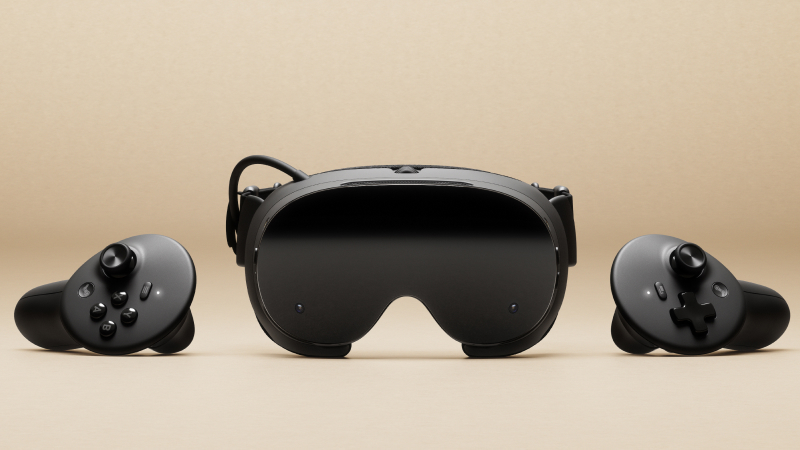
256 GB model: $1,059 USD
1TB model: $1,299 USD
Preorder list randomized, goes out Sept 17th
Power supply not included, costs $29 (same as Steam Deck power supply)
3rd party addon available for color passthrough, Arcturus Vision Camera, $149
256 GB model: $1,059 USD
1TB model: $1,299 USD
Preorder list randomized, goes out Sept 17th
Power supply not included, costs $29 (same as Steam Deck power supply)
3rd party addon available for color passthrough, Arcturus Vision Camera, $149
Had a VR headset but didn’t really use it enough to justify the cost tbh. These are double the cost too.
If I had that much money to spend I think it would be better to spend it on a screen instead of a VR headset. Should look up screens actually, aren’t they usually getting better/cheaper still unlike all other components? Could probably get a really nice screen for the cost of an RTXanything at this point.
Not that my current one is bad though. 1440p 144hz, think its only like 5 years old. Of course £1k could get something much better.
Same here, luckily I didn’t pay for mine, work paid for it
I am on the nice monitor bandwagon and I strongly recommend geting something with a VESA DisplayHDR True Black certification. Also 4K is very enjoyable if you can get it, you can always decrease resolution for FPS when gaming but the crispness of text and interfaces while doing desktop things is very nice.
What is HDR support on Linux like these days? Not looked into it too much as I am pretty sure my monitor isn’t HDR.
Would love to see some different monitors to actually compare tbh. My current screen essentially has built in motion blur, most visible with text if moved across the screen there is a slight trail behind it. I think its a common thing on loads of screens but some are better than others.
That kinda stuff also gets into the area where its harder to tell which screen is better, resolution and refresh rate are easy stats to look at.
Pretty good for KDE and GNOME at least. Both DEs support HDR monitors with pretty easy setup now. MPV and GNOME Videos both support HDR for your properly obtained movie files, idk about KDE’s video player. Browser support is still lagging, experimental HDR on Firefox usually works for videos when enabled but photos less so. Photography tools like Darktable and GIMP do not support it yet.
HDR for video games running on proton is something I haven’t tried enough to tell you. I know people have it working, but I think it sometimes requires messing about with proton environment variables.
Once you learn about the color gamuts of different displays and the HDR certifications they are also easy stats to look at. It all depends on your priorities though. Whether it’s maximizing refresh rate and fps for competitive games or doing art or having high resolution for productivity, it all changes the tradeoffs.
Many monitors nowadays support 100% DCI-P3 color gamut and that’s what most HDR media is mastered for, so that’s a pretty easy one to look for. The VESA DisplayHDR certifications also make it easy. True Black means the contrast ratio is very good for dark detail like with OLED. The number of the certification is the peak brightness in nits that the display can reasonably produce. So DisplayHDR True Black 600 would mean good contrast and 600 nit peak brightness. And a DisplayHDR 1600 would be able to go much brighter, but not necessarily have inky blacks like an OLED.
If you want something that cuts down on motion blur, the website BlurBusters.com is still an excellent resource.