
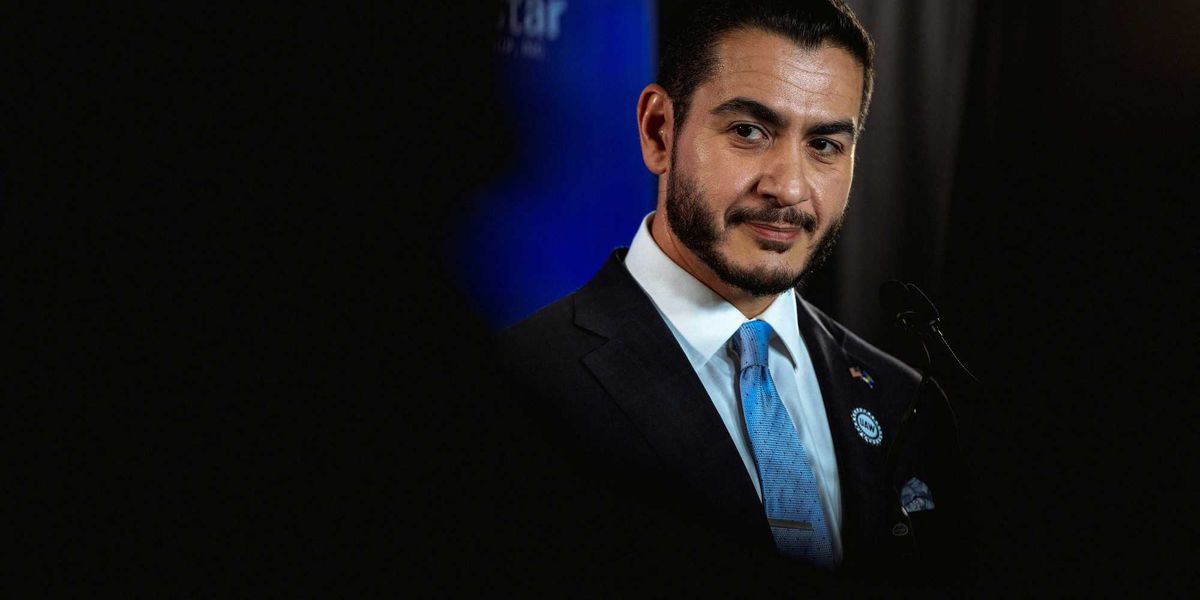
The attendee who pressed Democratic Senate nominee Abdul El-Sayed to disavow the Muslim Brotherhood at a tense town hall this weekend was exposed as a former GOP staffer with “Christian nationalist ties,” journalist Marisa Kabas reported.
As first reported by Kabas on her Substack The Handbasket, Tommy was actually Thomas Teepell, who previously served as operations director for Sen. Josh Hawley (R-MO) until February of this year.
Teepell’s father is Timmy Teepell, a GOP strategist who worked for former Louisiana Gov. Bobby Jindal through his climb from congressman to governor. Jindal is the founder of America Next, a conservative PAC that, according to The Michigan Daily, offered Republican college students $200 to travel to an El-Sayed event to “heckle” the Democratic candidate and ask provocative questions.
I mean who did Nat-C that coming?
Link to the clip this article is referring to
I heard Ted Cruz is posting a video of this interaction and is calling it a win for republicans. I dont visit those sites so I did not confirm.
Ted Cruz would call Trump shitting himself a win for Republicans
Found the 4 minute exchange shown in the article on El-Sayed’s BlueSky instead of xitter: https://bsky.app/profile/abdulelsayed.bsky.social/post/3my4gocauzs2x (Another person posted a Mastodon re-up if you prefer that)
It’s worth a watch, it’s so good that you’d think El-Sayed’s campaign tried to set this moment up yet in fact it’s the right-wing provocateur that came in thinking they could get soundbites insinuating Abdul is a terrorist, but went away with their clock cleaned instead.
I only saw the first 2.5 minutes previously, but the finish is baller. El-Sayed has some swagger
I hope enough Michiganders agree with me Nov 3
This so much… I would have easily believed that they paid this creep to show up and blow the dog-whistle.
The response was so perfect that it feels like a campaign stunt.
Now it’s blowing up everywhere and people get to see both how incredibly poised Dr. El-Sayed was as he explained his position (especially with the stark comparison to how the GOP typically handles people who ask them unfavorable questions at events) AND that it’s really the GOP pulling pathetic stunts like this with paid actors.
This guy and candidates like him give me a tiny glimmer of hope that maybe we can find some real leadership out there and start getting this disaster of the past decade turned around. Small hope mind you, but it’s definitely there.
I agree the response is so good that it feels scripted, but the truth is probably that he has it kind of scripted in his head. He’s probably dealt with similar questions or attacks many many times so by now it’s not surprising that he has this type of immaculate answer to it ready to deliver.
I had just already assumed that, but good to know it’s been confirmed.
And dude was properly shutdown by El-Sayed and exposed for the hypocrisy him and his group stand for.
*he and his group
“Him and his group” is grammatical here for some dialects of American English (and maybe others too).
One common explanation for this phenomenon is the idea of “default case”, but first we have to explain the idea of “case”.
Personal pronouns in English change form depending on where they are in the sentence; the first-person personal pronoun, for example, is “I” when it appears in (or “is licensed by”) subject position, and is “me” everywhere else. This difference based on syntactic (word) position is one example of a widespread crosslinguistic phenomenon we call “case”. We usually say that “I” is “Nominative” case, and “me” is either “accusative” or “oblique”.
Anyway, “default case” is the idea that each language picks a case to appear in positions that aren’t licensed by specific syntactic positions.
In Modern English (but not older English!) the default case appears to be the accusative/oblique. This is why, in English, the answer to the question “Who wants ice cream?” is “Me!” and not “I!”
In Spanish, however, where the default case is Nominative, the answer is “Yo”, not “mí”.
The fact that default case has switched from Nominative to Accusative in English has had a number of effects over the years. Answering the phone, for example, has gone from the archaic “This is she” to the more modern “this is her”.
Note, in this example, that the pronoun does not appear in a canonical subject position, making it much more likely to be affected/governed by default case. So, in older English we saw Nominative, but in Present Day English we often get Accusative/Oblique in many dialects.
Another place where case is famously wonky is with conjunctions, especially “and”. It seems that when a noun stands by itself, it always gets the expected case for that position (as we would expect), but when nouns are joined by a conjunction in the same position, it’s common for default case to be assigned instead, often alongside the idea that the “case-assigning position” (in this case subject position) “can’t see down into the conjunction”.
This leads to alternations like “I went to the store”, but with a conjunction, “Him and me went to the store.”
And this is exactly what we see here. In these dialects we get the expected Nominative case when the noun appears by itself, but we instead get default case when the conjunction blocks case assignment (or feature agreement, or however your preferred theory deals with case).
I’m writing an addendum about hypercorrection, so check back in with this comment in 10 minutes or so to read about it!
You are clearly more educated than I (or me) about the evolution of English but I will go to my grave bristling at this usage. Luckily for all y’all, I’ve one foot in already. But when “Bob and me” agree to be my pallbearers, I will literally sit up in my casket and scream my head off.
about the evolution of English but I will go to my grave bristling at this usage. Luckily for all y’all,
wtf is all y’all?
“All y’all” is actually a really interesting linguistic object. It draws a grammaticalized contrast between a 2nd person plural exclusive and a 2nd person plural inclusive, which isn’t really a thing in English elsewhere, even back in Old English when it had more complex morphology.
That is to say, “y’all” is a second person plural, and it basically means “you guys”, or “y’inz” if you’re from that part of Pennsylvania. It picks out a specific group of people that you’re talking directly to.
But, what if I’m talking to a crowd, and I want to draw a distinction between some people among them that I’ve already addressed, versus the group in its entirety, which I would now like to address?
This is where “all y’all” comes in. It essentially specifies that everyone is being addressed, and not just a specific subset of that group.
So you’ll get examples like “Y’all (usually with a pointing motion) need to rethink your design, but all y’all need to listen better”.
@[email protected] likely intended “all y’all” to have a specifically inclusive meaning here for a few different types of groups that could be distinguished among the readers of their comment. Basically, “not just y’all (the linguists in the group who are irked by their prescriptiveness), but all y’all (everyone else as well, including those who aren’t irked), are lucky that they have one foot in the grave”.
“All y’all” was necessary here because if they’d just said “y’all” it could easily have been misinterpreted as just the educated linguists being lucky, and they wanted to emphasize that their comment wasn’t being snide toward educated people, but rather self-deprecating. “All y’all” accomplishes that perfectly (for those who have it in their grammars).
“All y’all” is one of favorite constructions in (dialectal) English, though it is hilariously ironic, and kinda demonstrative of my general point, to see such a non-standard feature in a comment arguing in favor of prescriptive grammar rules!
(Also, if you think “all y’all” is weird, wait 'til you see singular y’all!)
@[email protected] was just having a little fun 🙃
Well, you know… you / y’all / all y’all 🙂
I think it’s perfectly fine to have personal preferences. That’s only human. I, for example, get driven up the wall by people using the blend “weary of something” instead of using either “leery” or “wary”, which are the two words that got blended together into this modern usage of “weary”.
The important things are to remember 1) that these preferences are subjective, not objective, and 2) to make sure that we don’t treat people differently or look down on them because of the way they speak (or write).
Being “weary” is being “tired”, is it not? It would seem to be a perfectly cromulent way to use the word.
They use it to mean “concerned” or “wary”. Like, “I’m kinda interested in the new Star Wars Galactic Racer game, but I’m weary that it’ll have some sort of AAA bullshit that will ruin my experience.” There are tons of grammar articles like this one from Merriam-Webster (https://www.merriam-webster.com/grammar/weary-vs-wary-difference-usage) clarifying the two because of how common this has become in recent years.
I’ll edit my previous comment to make what I mean clearer.
Yes, understanding what a word means helps. I use weary, leery, and wary distinctly as I know their definitions. Being an imperfect human I also conflate other words sometimes. When it does happen, and I catch it, I attempt to correct myself as I want to impart my thoughts in a clear and comprehensive manner. Mostly. 😬
This particular abomination/identity crisis seems to creep in when people are trying to sound sophisticated, and i just can’t with it.
I should know better than to argue with you about linguistics (because I remember you have an advanced degree in it from a previous conversation), but…
I’m going to go ahead and put my foot down and say that using “weary” to mean “wary” is just wrong usage. Like saying “it would be hoo of you” instead of “it would behoove you.” It’s just bone-apple-tea seen in the wild.
Now I will agree with point 2 in that it isn’t grounds to look down on someone or treat them poorly. If it’s in a context where it can be gently corrected without patronizing, it should be. Otherwise we should just let it go. But that doesn’t make it any less incorrect.
Any attempt by phd candidates to retrofit an explanation for it is just “explaining away” and reflects more the overly-permissiveness of modern academia and the hesitancy (especially in humanities fields where subjectivity is like water to a fish) to make firm corrections, especially in cases where cultural relativity might be argued.
I mean sure, language evolves and theoretically a dialect could emerge in which words that previously meant some things could take on completely different meanings. But if we accept that as the official “correct” stance in the field of linguistics, then the field of linguistics itself loses relevancy. Because if nothing can be wrong, then nothing can be correct either. Words will lose their meanings over time and it will become impossible to communicate across cultural barriers. You can already see this phenomenon if you pay attention to words that have taken on euphemistic meanings, especially in the contexts of intergenerational communication, which I would argue is a form of cultural barrier. For instance, “pussy” still means “cat” to many people of a certain age. That’s an extreme example, but that sort of thing can create miscommunications. Especially when it comes to more obscure innuendos or newer ones that aren’t as widely familiar to people.
The phenomenon isn’t limited to innuendo though. The whole basis of language is a mutual understanding of represented meanings. If we lose that consensus, then language itself begins to break down and become no longer an effective basis for communication. Carried to extremes, we find ourselves returning to meaningless/inarticulate grunts (not that we’re likely to reach that extreme, especially not within the lifetime of anyone living today; but it’s about the trajectory).
First of all, thanks for the response! I love talking about this stuff, and will do so every chance I get!
using “weary” to mean “wary” is just wrong usage. Like saying “it would be hoo of you” instead of “it would behoove you.” It’s just bone-apple-tea seen in the wild.
Language as a system is inherently a constant, mass negotiation among its users. Its relationship to meaning is (with a tiny number of exceptions) completely arbitrary, which means that if speakers unconsciously agree to use “it would bee hoo of you” to mean “it would behoove you”, then that is literally the correct usage. Merriam-Webster agrees with me - language is defined by usage, not by an obsolete code of speakers priviledged enough to have access to the secret knowledge of “correct grammar”.
There is an argument that using “weary” in this way is still marginal, and so is still ungrammatical for most speakers (myself included), but it’s definitely widespread enough for a linguist to consider it correct for many younger speakers (even if it irks me to admit it).
If it’s in a context where it can be gently corrected without patronizing, it should be.
This depends on your perspective, I suppose. Few people actually understand how language works, and even fewer are willing to be non-discriminatory in practice, which means that, unfortunately, using a word that others perceive as “incorrect”, even when they’re wrong about that (which is pretty much always, including here), can have negative social consequences.
For this reason, and this reason alone, I can support the idea of gentle correction.
However, if by some miracle humans become less tribalistic, and start treating language descriptively and objectively, then there will no longer be a reason to “correct”, because we will have realized that there was nothing to correct in the first place.
(Note that this obviously excludes children and second language learners - they do produce ungrammatical sentences, but this is categorically different than saying “weary” instead of “wary”.)
Any attempt by phd candidates to retrofit an explanation for it is just “explaining away” and reflects more the overly-permissiveness of modern academia and the hesitancy (especially in humanities fields where subjectivity is like water to a fish) to make firm corrections, especially in cases where cultural relativity might be argued.
I was a (non-tenured) professor of linguistics for almost a decade, not just a PhD candidate.
Also, this isn’t “explaining away”. Linguists have known that this is how language works since at least the late 1800s, and especially by the time of de Saussure’s “Course in General Linguistics” in the early 1910s, so I’m not sure where you’re getting “the permissiveness of modern academia”.
Language is a system built on usage, and it’s been known that that was the case for the majority of the time that we’ve been studying it scientifically. See Merriam-Webster’s article above - this is a fact that is universally accepted not only by linguists, but also by lexicographers. Merriam-Webster does have a disambiguation page on “weary vs. wary”, but I can guarantee you than within a decade they will have updated their definition to reflect usage.
I mean sure, language evolves and theoretically a dialect could emerge in which words that previously meant some things could take on completely different meanings. But if we accept that as the official “correct” stance in the field of linguistics, then the field of linguistics itself loses relevancy. Because if nothing can be wrong, then nothing can be correct either.
This is a fundamental misunderstanding of the study of linguistics (which is understandable, since it’s unfortunately not a commonly understood field among laypeople). Linguistics is the study of the human capacity to produce a system that we call language. The only thing we care about is accurately describing the nature of that system and how it exists in the mind of a speaker.
We have no interest in what people think is “right” or “wrong”, because these value judgments are subjective and do not in any way reflect linguistic reality - we only care about the nature of the system itself as it is actually spoken by humans, and this has always been the case.
However, we do make a distinction between utterances that are grammatical and those that are ungrammatical. This is defined, of course, by usage, and it is naturally consistent and rule-governed in all languages/dialects, both standard and nonstandard. A grammatical utterance is one that would be unconsciously produced by the linguistic apparatus of a native speaker of a language, and an ungrammatical utterance is one that would not be produced by that system.
In fact, linguistically defined, if it takes conscious effort for you to not split infinitives or end sentences with prepositions, then speaking “correctly” is actually ungrammatical!
Words will lose their meanings over time and it will become impossible to communicate across cultural barriers. You can already see this phenomenon if you pay attention to words that have taken on euphemistic meanings, especially in the contexts of intergenerational communication, which I would argue is a form of cultural barrier. For instance, “pussy” still means “cat” to many people of a certain age. That’s an extreme example, but that sort of thing can create miscommunications. Especially when it comes to more obscure innuendos or newer ones that aren’t as widely familiar to people.
Since the dawn of recorded history old curmudgeons who have seen their language change around them have decried how the youth are destroying language, how it will devolve into meaningless grunts and how we will lose all ability to communicate. This seems to be a human universal, from the ancient Greeks to the ancient Japanese.
However, after literally thousands of years of this “devolution”, we still haven’t seen this happen.
Why? Is it because we have righteous grammar warriors who fight the good fight of enforcing archaic and arbitrary restrictions?
Nope. It’s because all dialects, etc., still have self-organizing, well-defined rules of about the same general complexity. There is no “devolution” because language is an innate, universal human behavior that follows specific types of rules and general patterns. That is, linguistic systems’ interactive and negotiative nature means that they naturally self-correct - they don’t need anyone to do it for them.
As for the idea that English will splinter into unintelligible dialects, this is again countered by the facts of language usage. It’s currently valuable and important to English speakers across the world that they be able to communicate successfully with each other, and as long as this pressure exists, they will continue to be able to do so.
Once again, this isn’t because there’s a universal English police enforcing outdated rules like not splitting infinitives - it’s because the (incredibly large) speech community benefits from continuing to communicate, and so they will naturally, because that’s how humans are programmed.
To do so, of course, “English” defined broadly has already had a sort of lingua franca version of itself develop naturally, and each English-speaking place in the world already has their own variation of this organic “standard”, and yet they’re all still able to communicate among each other simply because it is necessary that they do so. Once again, this is not because of internet grammar Nazis, but because that’s literally how language works.
As for your example of intergenerational miscommunication, this will inevitably occur anyway due to language change. Miscommunication and ambiguity is inherent to language and cannot be legislated away, because, again, it’s inherent to the system.
Instead, when there is (inevitably) a miscommunication, the solution is quite simple. It’s the same solution older generations and younger generations have been using since the dawn of humankind: both speakers can simply explain what they meant, or define new terminology, and communication can proceed just as well as it did previously.
The whole basis of language is a mutual understanding of represented meanings. If we lose that consensus, then language itself begins to break down and become no longer an effective basis for communication.
This is correct, but as long as speakers are in communication with each other, this cannot happen, because that’s the nature of language. Language is communication, and its systemic nature is defined by that communication. This means that as long as communication continues to happen between the groups, their language will continue to be understandable.
Now, it is of course the case that if all communication suddenly ceased for a few hundred years, then yes, the two groups of speakers would likely lose the ability to communicate with each other. But in our modern world of super interconnectivity, that’s incredibly unlikely to happen among the vast majority of English speakers.
Carried to extremes, we find ourselves returning to meaningless/inarticulate grunts (not that we’re likely to reach that extreme, especially not within the lifetime of anyone living today; but it’s about the trajectory).
As explained above (and as demonstrated by thousands of years of human history), this trajectory does not exist, because that’s not how language works.
I hope this has been understandable and informative. I’m busy for the next four or so hours, but let me know if there’s anything that doesn’t make sense, or anything you’d like more detailed explanation of, and I’ll be happy to respond.
Again, I love talking about this stuff and will answer literally any question about linguistics that you’ll let me! :)
Thanks for sharing - that’s good to know!
First of all, it was a grown man who introduced himself as Tommy, whose father goes by Timmy, who worked for a politician named Bobby. What’s with these weirdos who never transitioned from their elementary school names?
Secondly, what’s the deal with these White Christian Nationalists dogging anyone else over their religion? These delusional Christian psychos are literally no different from the Muslim extremist psychos they condemn. They are two sides of the same coin.
Abdul should have asked Tommy if he disavows White Christian Nationalism.
Religon is on a pathway to kill humanity.
Religion is just the tool, it’s the antisocial and murderous reactionary ideologies pushed through major religions that allows it. Christianity in particular does have a lot of ways of condoning imperialism etc but I believe it can be for good, there have been numerous Christian groups that broke away from the mainstream and said that to follow the scriptures required a form of socialism. I was raised with a Buddhist leaning upbringing, and it instilled in me ideals like a respect for all life and different cultures, to persue a harmony between humanity and nature, but also allows a scientific and materialist view rather than pure idealism.
Idealism is a fraud
… he did, didn’t he?
He did and Tommy said no.
Not by name, no.
The video is in the linked article. Abdul asked Tommy around the 30 second mark if Tommy disavows the Muslim Brotherhood as a reflexive response to Tommy’s own question, and at 4:20 he asked Tommy if, as a Christian, Tommy disavows “any attempt to read Christian doctrine into the laws of our country?” and of course Tommy declines.
But Abdul never asks Tommy if he disavows White Christian Nationalism.
a grown man who introduced himself as Tommy, whose father goes by Timmy, who worked for a politician named Bobby.
It’s the South, what do you expect
It is definitely a thing in the South, and didn’t realize it until I moved out.
Everybody knows the answer to it, answer the question
This was so great. I got goosebumps. El-Sayed has impressed me with everything I have seen.
The way Tommyboy just left with his tail between his legs 🤌
Bye bitch
I wanna know who that other guy who left with him is. The one he walked out with.
Not that you or anyone here would know, it’s just that no one participates in a walk of shame unless they have to, and it’s pretty clear they were there together.
So this Tommy chud is one of those paid actors Republicans are always shrieking about, huh?
Tommy too. No offense to “Tommy” name havers; but holy shit, you drop it to Tom around the same age you stop wearing baseball caps backwards. This guy isn’t even following basic white cis-het male rules.
His ilk usually don’t age past the baseball cap age mentally.
It’s a specific tactic that politicians use. “Tommy” sounds more approachable than “Tom” or “Thomas.”
This is why we know Charles Schumer as “Chuck” and Addison McConnell III as “Mitch.” The folksy name feels friendlier and therefore gets more votes.
If you trace all the money going into America Next PAC, I bet there’s a good chance we’d find Russian money. So odds are this guy was a Russian paid actor.
This guy almost certainly came in from out of state, too: worked for Josh Hawley of Missouri, works for a PAC belonging to ex-governor Bobby Jindal of Louisiana, hard to believe he actually lives in Michigan, much less in Caro, which appears to be a rural mid-state town.
One remembers all those accusations from the right-wing that people showing up at protests are bused in, not local, etc.
Yet here’s this Missouri/Louisiana linked chud showing up out of nowhere at a Caro, Michigan town hall, run by a candidate for Senate that is not even of his own party. Hmmm.
Something something accusations and projections…
They’re always harping on about paid actors because they’re doing it themselves and they just assume that everyone else is as well.
It’s the poor empathy thing again. They can’t really imagine someone else as different than themselves.
Abdul: So I’m going to ask you, do you disavow any attempt to read any religious doctrine into the laws of our country?
Tommy: I do not.
Abdul: You don’t disavow that. So, I think it’s you who needs to understand the Constitution, not me.
El-Sayed played him like a fiddle. Rock on.
I hate Republicans like I’m so past the point of tolerating them but damn if I didn’t self-cringe listening to that ass whooping poor little Tommy just got
Must’ve been such a deer in the headlights moment for him. He didn’t even do what Republicans do best and lie
Yeah, but The News won’t cover that part.
The scene was embarrassing enough for the prick already. The fact that it was organized and planned, and he still had no plan whatsoever for what to do if El-Sayed simply said “Yes, I do condemn the Muslim Brotherhood” really goes to show how fucking weird and disconnected from reality these people are.
The GOP operative wasn’t willing to disavow militant Christians, so he didn’t think El-Sayed would disavow militant Muslims.
What a dumbass.
I’m shocked! Shocked, I tell you!
Jesus could turn water into wine, but a Christian Nationalist can turn alcohol into domestic violence.
This unfortunately, too real
Thomas Teepell was basically projecting? They have dual loyalties, one to a secular government, and a second to Christianity.
I wouldn’t say they’re doing well at either of those projects tbh.
The Founding Fathers vs. the Christian Nationalist
The most revealing way to stage this debate is to put the American founders in a room with a modern Christian nationalist and ask one question:
Does America belong to Christianity, or does Christianity belong to the freedom of Americans?
That distinction gets straight to the constitutional problem. The founders were not a unified group of secular liberals, and many believed Christianity was important to public morality. But they disagreed about religious authority, political power, and what kind of republic America should become.
Imagine a debate in Philadelphia, circa 1787, with the Constitution on the table.
Act I: The debate begins
James Madison: The constitutionalist
“On what authority do you claim the right to govern the conscience of your neighbor?”
Madison would attack the political structure of Christian nationalism before arguing about theology. In his 1785 Memorial and Remonstrance Against Religious Assessments, he argued that religious belief must arise from conviction, not coercion, and that government has no legitimate authority to dictate religious obligations.
His challenge would be straightforward: if the state can privilege your denomination today, what prevents a rival denomination from taking control tomorrow?
His verdict: A religious majority does not acquire unlimited political authority simply by being a majority.
Thomas Jefferson: The radical skeptic
“Can a government compel belief without corrupting both liberty and religion?”
Jefferson would be particularly hostile to religious tests and state-sponsored orthodoxy. His Virginia Statute for Religious Freedom, enacted in 1786, rejected compulsory religious observance and the use of civil rights as rewards for religious conformity.
He would ask the Christian nationalist whether a citizen who rejects Christianity can remain an equal citizen, hold office, and criticize the government without being treated as an enemy of the nation.
If the answer were no, Jefferson would see the project as a revival of the very religious coercion that revolutionary Americans had reason to oppose.
His verdict: The government has no business grading citizens by the contents of their souls.
George Washington: The pragmatic unifier
“A government must unite citizens who do not worship alike.”
Washington was more publicly comfortable with religious language than Jefferson, but his conception of American citizenship was not supposed to depend on belonging to the dominant faith.
In his 1790 letter to the Hebrew Congregation of Newport, Rhode Island, Washington declared that citizens possessed equal liberty of conscience and equal civil standing. He rejected the notion that religious minorities merely enjoyed the majority’s gracious permission to exist.
Washington’s concern would be political stability: a republic divided into religious insiders and outsiders risks turning disagreement over doctrine into a struggle for power.
His verdict: Religious liberty is a foundation of national unity, not a concession granted by Christians to everyone else.
John Adams: The moral realist
“A constitution is made for a moral people. It is wholly inadequate to the government of any other.”
Adams, in his 1798 address to the Massachusetts militia, made that famous observation about constitutional government and morality. He believed republican institutions required public virtue, but that is not the same as giving one religious movement a monopoly on national identity.
Adams also signed the 1797 Treaty of Tripoli, which included a declaration that the American government was not founded on the Christian religion. The wording’s diplomatic context matters, but the treaty is still significant evidence against treating Christianity as the formal constitutional basis of the federal government
His verdict: Moral character matters enormously. Whether the state should enforce a particular theology is a different question.
Act II: The Christian nationalist makes the case
Imagine a modern Christian nationalist answering the founders:
“America’s founders believed in God. The Declaration invokes a Creator. Christian moral principles shaped our laws and culture. A nation cannot survive without a moral foundation, and abandoning Christianity means abandoning the values that made America great.”
This argument should not be dismissed as entirely fabricated. Religion genuinely influenced early American political culture, and the founders disagreed about theology, religious practice, and the proper role of faith in public life. Some were orthodox Christians; others held more skeptical or unconventional beliefs.
+1
But the nationalist’s argument makes a crucial leap:
- Historical influence: Christianity helped shape American culture.
- Moral argument: Christian teachings can contribute to public morality.
- Constitutional claim: The American state should privilege Christianity.
- Exclusionary claim: Full American identity or citizenship should depend on Christian affiliation.
The first two propositions do not logically establish the last two. A tradition can influence a country’s history without acquiring a perpetual right to govern it.
The founders would not all agree on every part of that rebuttal. But Madison and Jefferson, in particular, would have powerful objections to turning religious influence into legal privilege.
Act III: The argument becomes personal
Here is a dramatization of how the exchange might unfold. These are invented lines, not historical quotations, but the arguments are grounded in the founders’ documented positions.
IMAGINED CONSTITUTIONAL CONVENTION
Christian Nationalist: “Our laws should reflect the Christian values that built this country.”
Madison: “Which Christian values? And whose interpretation shall have the force of law? The Baptist, the Anglican, the Presbyterian? You have not solved the problem of religious division. You have merely appointed one faction to settle it.”
Christian Nationalist: “But the majority is Christian. Surely democracy means the majority gets to decide.”
Jefferson: “A majority may elect representatives. It does not thereby acquire ownership of another person’s conscience.”
Christian Nationalist: “You cannot build a nation without shared moral principles.”
Adams: “That is a serious argument for civic virtue. It is not yet an argument for a state church. Demonstrate that religious uniformity is necessary, rather than merely familiar.”
Christian Nationalist: “Without Christianity, America loses its identity.”
Washington: “A country whose citizens must profess the correct faith to enjoy equal standing has confused national unity with religious conformity.”
Christian Nationalist: “Then you would allow people who reject Christianity to influence America’s future?”
Madison: “If you deny them that right because of their beliefs, you have abandoned the principle of equal liberty you claim to defend.”
The room falls silent. Someone asks whether the delegates can return to the question of federal taxation. The eighteenth century, like every century, has paperwork.
Act IV: The founders’ strongest arguments against Christian nationalism
Three arguments would likely dominate the debate.
1. The problem of political legitimacy
If government derives its authority from the people, how can it legitimately subordinate citizens because they reject a particular religious doctrine?
The Declaration of Independence invokes a Creator and natural rights. It does not establish that Christian churches possess governing authority. Moving from the proposition that rights have a divine source to the proposition that a particular religious movement should control the state requires an additional argument.
2. The problem of minority rights
Madison’s concern was not simply that religious persecution is unpleasant. It was that political power can be used to violate rights even when the majority believes it is acting correctly.
His argument applies equally to a Christian majority discriminating against atheists, a Catholic government discriminating against Protestants, or a secular government discriminating against Christians. The principle is symmetrical: religious liberty cannot depend on who happens to hold power.
(ctd…)
Fuck off with your ai slop.
its better than your anger/hate slop
(…ctd)
- The problem of precedent
Once the government acquires the power to define the nation’s officially favored faith, what limits that power?
Madison explicitly warned that a power capable of establishing Christianity could also establish one Christian sect over another. The danger is institutional, not merely theological: the machinery of religious privilege can be inherited by whoever next controls the state.
Teaching American History
Act V: The uncomfortable historical complication It would be historically dishonest to portray every founder as a modern secular pluralist. Several states retained religious establishments or religious qualifications into the early republic. Many founders used providential language, believed religion encouraged virtue, and held views of religious equality that fell far short of modern standards. The republic they created also excluded many people from full political participation.
There is a second distinction worth preserving: a religiously influenced republic is not the same thing as a republic constitutionally subordinated to religion.
The federal Constitution prohibits religious tests for federal office in Article VI. The First Amendment prohibits Congress from establishing a religion and protects its free exercise. These provisions do not require citizens to keep religious convictions out of politics. They constrain the government’s authority over religious belief and practice.
The 1797 Treaty of Tripoli offers additional evidence. Its famous declaration that the American government was not founded on the Christian religion was part of a diplomatic agreement, and historians debate how broadly to interpret it. It should not be treated as proof that every founder was secular.
The First Amendment Encyclopedia +1
That nuance actually strengthens the central argument. You do not need to claim that the founders were atheists, that Christianity had no influence, or that they anticipated every modern conception of equality.
You need only distinguish between their religious beliefs and the constitutional powers they authorized. The final verdict If we asked the founders to vote on Christian nationalism as a single, clearly defined political doctrine, we would be imposing a modern label on a divided historical group. Their answers would depend on what the doctrine demanded.
- If it meant Christians participating freely in politics, defending their moral convictions, and persuading fellow citizens, many founders would have had no objection.
- If it meant recognizing Christianity’s historical influence on American culture, many would have agreed, although they would disagree about the significance of that history.
- If it meant granting Christians superior citizenship, imposing religious conformity, or making adherence to Christian doctrine a condition of legitimate political participation, Madison and Jefferson would have particularly forceful objections. Washington’s statements on equal liberty of conscience would also be difficult to reconcile with such a system. The deepest question is not whether Christianity influenced America. It plainly did.
It is whether a political community can claim to defend freedom while reserving the authority to decide which citizens possess the correct ultimate beliefs.
The strongest Madisonian answer would be that a government established to protect liberty cannot make the liberty of conscience conditional on agreeing with the majority’s theology.
And the most ironic possibility is that a movement claiming to restore the founders’ legacy could undermine one of their most important institutional achievements: a constitutional government whose legitimacy does not depend on establishing a single religious orthodoxy.
That is the argument worth having, rather than the historically weaker shouting match over whether the founders were all Christians or all secularists.
source I asked GPT “express to me how the founding fathers of the usa might debate the concept of a Christian Nationalist?”
AI;DR
I appreciate your comment, because it points out that what I thought was unhinged fan fiction that I should skip is actually unhinged fan fiction written by a word-prediction machine, and therefore even less deserving of my time and attention.